
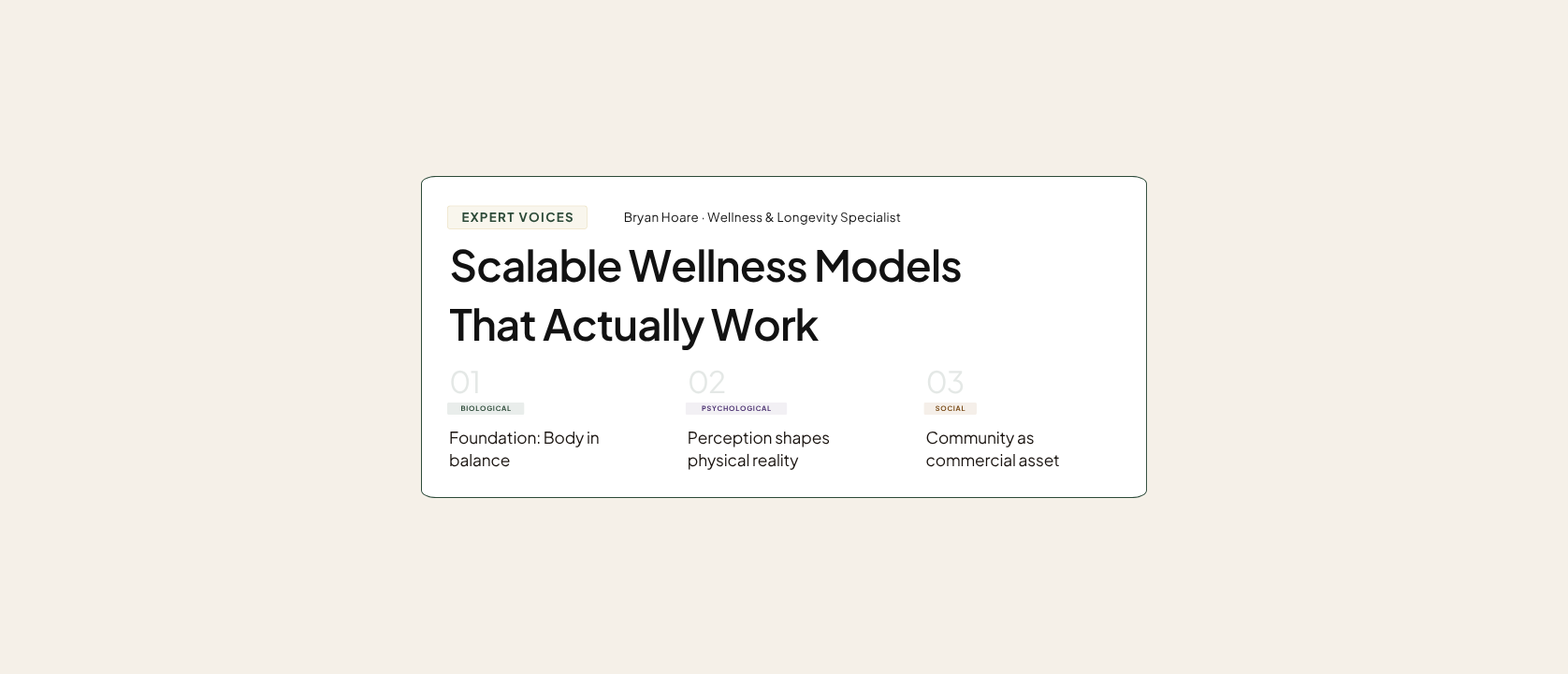
Based on an Infoquest Expert Voices interview with Bryan Hoare, Wellness and Longevity Specialist
The wellness industry has a vocabulary problem. It stacks terms like “holistic integration” and “transformative protocols” onto what Bryan Hoare, a wellness and exercise physiology specialist with more than four decades of experience, describes as something far simpler: eat well, sleep, and move. Once those foundations are in place, everything else follows.
Hoare has spent his career working across destination spas, addiction medicine programs, private clubs, and hotel brands in more than 25 countries. He has seen what happens when companies treat wellness as a marketing layer rather than a functional system. The result is usually short-lived. What lasts, he argues, is something clinical: the biopsychosocial model.
A Framework Hospitals Already Know
“These are three integrated but differentiated areas,” Hoare explains. “The biology, the psychology, and the social aspect of health and wellness. If you can get the three in balance, you can deal with difficult situations in life.” It is a framework that hospitals and pain specialists have used for years. The wellness industry is only beginning to catch up.
The biological layer covers the basics: nutrition, sleep, physical activity. When this is functioning well, the body’s biochemistry comes into balance and it becomes far easier to manage stress, process difficult emotions, and maintain meaningful relationships. Hoare is direct about cause and effect here. When the biological foundation slips, everything else tends to follow.
The psychological layer covers cognition, behavior, and the way individuals interpret the world around them. Hoare points to pain management as a useful illustration. A person with a sore shoulder who is also experiencing relationship stress will typically report more pain, not because the physiology has changed, but because the psychological context amplifies the signal. The biopsychosocial model accounts for this.
The social layer, the third dimension, is about community and relationships. Hoare connects this to meaning, citing Viktor Frankl’s work on finding purpose even in extreme circumstances. In a business context, he sees this as a significant commercial opportunity: developments and clubs that build genuine communities, rather than selling amenities, can multiply the value of their product.
Expert Framework
The Biopsychosocial Model in Wellness
The three integrated dimensions every wellness strategy must address, according to Bryan Hoare.
Dimension 1
Biological
- Nutrition and diet quality
- Sleep duration and quality
- Physical movement and exercise
- Biochemistry and physiology
- Substance use and avoidance
Dimension 2
Psychological
- Stress recognition and management
- Cognition and mental frameworks
- Behavioral patterns and habits
- Emotional regulation
- Mindfulness and breathwork
Dimension 3
Social
- Community and belonging
- Meaningful relationships
- Shared purpose and values
- Support networks
- Cultural and spiritual context
Key insight: When the biological foundation is strong, the body’s biochemistry comes into balance — making it significantly easier to manage stress, regulate behavior, and sustain meaningful social connections. Each dimension reinforces the others. A gap in any one weakens the whole system.
Building Wellness Into the Brand
That commercial logic extends to how wellness is built and sold. Hoare’s most recent major project illustrates the approach in practice. Working with Oberoi Hotels and Resorts over 12 to 14 months, he helped develop and launch ASMI, a new wellness architecture for the group’s 32 properties. ASMI is a Sanskrit word meaning “I am,” reframed as “I am my choices.”
The model is organized around five pillars: movement, nutrition, bodywork, breathwork, and mindfulness. These map onto the biopsychosocial framework directly. The first two address biological basics. Bodywork covers physical care programs. Breathwork and mindfulness engage the psychological dimension. Taken together, they give the brand a structured, commercially legible offer.
“Guests can come on a wellness program,” Hoare explains. “You can pre-sell packages that people purchase before they arrive.” That shift from reactive upselling to pre-committed programs changes the economics. People come specifically for the offer, rather than being sold to on arrival. It also strengthens brand equity because the wellness model becomes the reason for visiting, not an add-on.
Scalability across properties was built into the design. In Delhi, the offer centers on movement, nutrition, and bodywork. At a Himalayan property like Wildflower, the full range, including intensive breathwork, becomes relevant. The framework holds; the application adapts.
Niche or Integrated: Choosing Your Position
For companies thinking about entering the wellness space, Hoare recommends choosing a strategic position within the biopsychosocial system rather than trying to address all three dimensions at once. A recovery-focused breathwork studio, like the 432 concept he references, scales well precisely because it is specific. Selfspace, a London-based counseling network, does the same by focusing on accessible, high-frequency mental health support.
Real estate developers or hospitality groups building for long-term residents, by contrast, need a more integrated model. The differentiation lies in the question of what the brand is actually trying to do for people and how broadly. Attempting to solve everything for everyone typically leads to diluted positioning and eroded brand equity.
Comparison Grid
Niche vs. Integrated Wellness Models
When to focus on one dimension of the biopsychosocial system — and when to address all three. Based on Bryan Hoare’s framework for wellness business strategy.
| Factor | Niche / Focused Model | Fully Integrated Model |
|---|---|---|
| Best for | Standalone urban wellness concepts, recovery studios, mental health access points | Hotels, residential developments, private clubs, destination spas |
| Biopsychosocial scope | One or two dimensions (e.g. biological + psychological only) | All three dimensions: biological, psychological, social |
| Scalability | High — replicable across multiple low-cost locations | Moderate — requires trained staff, space, and brand consistency |
| Capital required | Lower — lean format, minimal specialist infrastructure | Higher — programming, expert staff, facilities, tech integration |
| Brand equity path | Built through consistency and focused IP in a defined niche | Built through comprehensive guest transformation and community |
| Risk profile | Lower — narrow positioning reduces misstep surface area | Higher — complexity demands authentic delivery across all dimensions |
| Revenue model | Volume and accessibility; high-frequency, recurring visits | Pre-purchased packages, premium pricing, destination loyalty |
| Commercial example | 432 (breathwork + hot/cold), Selfspace (counseling, London) | Oberoi ASMI model, Six Senses, destination spa groups |
Niche Model
Selfspace, London
Six-plus accessible counseling centers across London. Focused on stress and mental health. Approachable, scalable, no high overhead.
Integrated Model
Oberoi ASMI
Five-pillar wellness architecture across 32 properties. Movement, nutrition, bodywork, breathwork, and mindfulness — adapted by location.
Authenticity as Brand Equity
On authenticity, Hoare is unambiguous. Wellness brands that rely on misinformation or overstatement eventually lose credibility, and once credibility is gone, so is brand equity. He uses Volkswagen’s emissions scandal as an analogy: doing great things and then being caught out can undo years of brand-building. The fix is not complicated. Share valid truths, build the marketing narrative on top of them, and make the model replicable.
Technology as a KPI, Not a Foundation
Technology sits alongside all of this, but Hoare places it in context. Wearables and biometrics function as KPIs for the body, particularly heart rate variability, which he identifies as the single best indicator of overall health. Useful for daily tracking. Not a substitute for the fundamentals.
His closing argument is almost a counterpoint to the technology conversation. The most expensive villa he ever sold, at a Maldivian resort, cost guests $85,000 a night. The main feature was that no one wore shoes. Simplicity as the luxury. The biopsychosocial model, like that offer, works because it meets something fundamental. The hard part is not the framework. It is building a product honest enough and focused enough to deliver on it.