
San Sanghera spent 30 years in financial services, 18 with HSBC and 12 with First Gulf Bank and First Abu Dhabi Bank, where he led group strategy and ran M&A identification and execution. He was at the heart of the FGB-NBAD merger, one of the largest banking combinations the region has ever seen. His deep involvement in GCC Mergers and Acquisitions gives him unique insight. When he talks about what makes GCC deals different, he is speaking from experience, not theory.
Three things that set GCC M&A apart
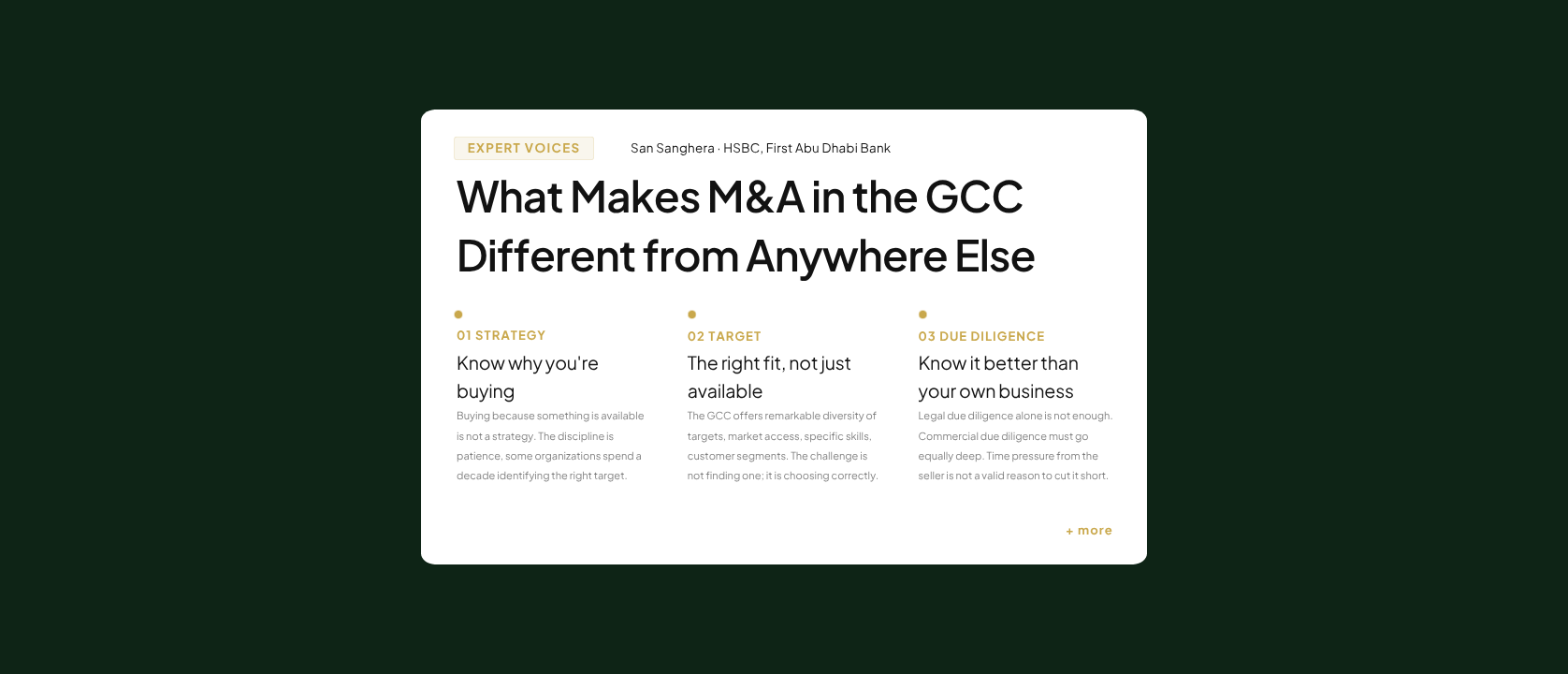
The first is the diversity and availability of targets. Whatever an acquirer is looking for, market access, specific skills, or customer segments, there is almost certainly something in the GCC that fits. The challenge is not finding a target; it is choosing the right one. That distinction matters more than it sounds.
The second is capital. Not just financial capital, which is obviously abundant across the region, but human and cultural capital too. The GCC has a culture that is comfortable making big decisions. That willingness to act decisively and at scale is itself a competitive advantage in deal-making. When you need to move, you can.
The third is culture, and Sanghera does not use that word lightly. “If you go into an M&A not thinking about culture, you are gone,” he says. “You will fail. You may do the transaction, but your business will fail.” Closing a deal is not the finish line. It is the starting gun. The two to three years that follow are where the real work happens, and culture is the variable most often underestimated.
The FGB-NBAD merger: what integration actually looks like
Sanghera was part of the ten-person integration management office when FGB and the National Bank of Abu Dhabi merged to create what was then the largest bank in the UAE and one of the largest in the Middle East. Two institutions, both with strong market positions, are being combined into something entirely new. The similarities made it manageable. The differences made it demanding.
The lesson he carries from that experience is deceptively simple: a merged entity needs a defined culture, not just a dominant one. In a genuine merger of equals, if you do not actively design the culture you want to build, whichever culture was stronger before the deal will absorb the other. That is rarely what either side intended.
A later acquisition added another layer of complexity. It was the first cross-border deal the combined organization had attempted, done entirely remotely, during lockdown, with legal and accounting teams spread across time zones. Project management, he says, was the single biggest determinant of whether it worked.
What acquirers get wrong
Sanghera is direct about where buyers fail. The first mistake is not understanding their own strategic rationale. Buying something because it is available is not a strategy. He has worked in organizations that spent a decade looking for the right acquisition in a specific market. Patience is part of the discipline.
The second failure is not understanding the market. An acquirer is, by definition, entering somewhere they do not already have full presence, which means relying on people who genuinely understand the local context, competitive landscape, and regulatory environment, not making assumptions based on how things look from the outside.
Third is insufficient due diligence. “You need to know this business almost better than you know your own business before you acquire,” Sanghera says. Legal due diligence alone is not enough. Commercial due diligence has to go equally deep, and time pressure from the other side is not a good reason to cut it short.
And finally, not understanding the process itself. M&A has a timeline, regulatory milestones, shareholder approval requirements, and legal steps that cannot be rushed or skipped. Deals fail when parties do not map this fully from the start.
The Four Pitfalls of GCC Acquirers
Most M&A failures trace back to one of these four gaps — and they compound when left unaddressed.
Buying because something is available is not a strategy. The acquisition must fulfill a defined need tied to your broader goals. Some deals take a decade to find — patience is part of the discipline.
You are entering a market precisely because you are not already there. That means relying on people who genuinely understand its competitive dynamics, regulatory landscape, and local context — not assumptions from the outside.
Due diligence needs to go beyond legal review. Commercial DD must be equally thorough. The standard: you should know the business almost better than you know your own before you sign. Anything less and you are buying an empty bag.
M&A has a defined timeline: formal DD, negotiation, legal steps, regulatory approval, shareholder sign-off. Failing to map this from day one — or allowing time pressure to compress any stage — is a reliable path to failure.
Post-merger integration: communication is the work
Communication is the through-line of successful integration. Not a single announcement, but ongoing, detailed, repeated updates, about what is changing, when, and what it means for each person in the organization. The talent you are acquiring is exactly the talent most likely to leave if they feel kept in the dark.
On KPIs, Sanghera is equally clear: they should be defined at the very beginning, tied directly to why the deal is being done in the first place. If the rationale was customer acquisition, measure customer numbers. If it were market access, that is what gets tracked. Beyond the headline metric, every integration should have something in each of the four areas: process, customers, employees, and financials. If any one of those is missing, something important is not being managed.
Post-Merger Integration: What to Measure
KPIs should be set at the start of the process — tied to the reason the deal was done. Then track something in each of the four quadrants below.
Systems integration milestones, operational efficiency metrics, technology cutover timelines. Are the two organizations running as one?
Retention rates, satisfaction scores, churn in key segments. Disruption to customers during integration is a risk that needs active monitoring, not just a late-stage review.
Attrition in key roles, engagement levels, clarity on terms and conditions. The talent being acquired is exactly what most often walks if communication is absent.
Revenue synergies, cost savings, return on capital. Financials tend to surface naturally — but they should still be tracked explicitly, not relied on as the only measure of success.
Three pieces of advice for anyone considering a deal
Do not underestimate the complexity. Even a deal that looks straightforward will not be. The cost of good advice early is a fraction of the cost of a bad decision downstream. Get the right expertise in the room from the beginning and listen to it.
Do your due diligence properly. Do not let artificial timelines compress it. If the seller is pushing for speed in a way that limits your ability to understand what you are buying, that is a signal worth taking seriously.
And be prepared to walk away. Being 75% through a transaction is not a reason to finish it if something no longer feels right. The sunk cost fallacy has closed more than a few deals that should have been stopped. An M&A is not a failure because it did not complete; it is a failure if it completes badly.