
An expert network brief is the written request you submit to an expert network firm describing the type of expert you need, the context for the engagement, and what you hope to learn. It’s the foundational document that drives every matching decision the network makes on your behalf.
Expert network firms use your brief to search their databases, evaluate candidate fit, and prioritize outreach. Every word you write shapes who ends up on your shortlist.
At Infoquest, we source experts through custom outreach rather than pre-built databases, which means the brief is even more critical because it guides our recruiters in reaching the right people from scratch rather than filtering a pre-existing pool.
The 6 Elements of a Strong Expert Network Brief
Every effective expert brief contains six core components. Missing any one of them introduces ambiguity that forces the network to make assumptions, and those assumptions may not match what you actually need.
1. Project Context (2–3 sentences)
Describe what you’re working on and why you need expert input. You don’t need to reveal client names or confidential deal details, but the network needs enough context to understand the purpose of the engagement. Are you in due diligence? Conducting market sizing? Informing a go-to-market strategy? This framing shapes everything.
2. Expert Profile (the most critical element)
Describe the type of person you need in terms of their role, industry, seniority, and geography. The more specific, the better. Vague language like “industry expert” or “someone with relevant experience” tells the network almost nothing. Spell out the job title, the type of company, the years of experience, and the geography, even if you’re flexible on some dimensions, stating your ideal helps the network prioritize.
3. Required Experience or Knowledge
What does this person need to have done, seen, or know? Specify the functional area, the markets they should have worked in, and any essential niche expertise. This section filters out experts who look right on paper but can’t answer your actual questions.
4. Questions or Topic Areas
Include at least 3–5 questions or topic areas you plan to cover. This serves two purposes: it helps the network assess whether a candidate can actually address your needs, and it helps the expert decide whether they’re the right fit before accepting the call. Vague briefs lead to misaligned calls; specific topic areas lead to productive ones.
5. Exclusions
State explicitly who you don’t want. Common exclusions include consultants and advisors (rather than operators), people who only know the topic from a vendor or buy-side perspective, experts from specific companies (competitors, clients, conflict targets), or those without direct decision-making experience. Exclusions are underused and disproportionately valuable.
6. Logistics
Timeline, number of calls needed, preferred call duration, and any compliance requirements. Providing this upfront prevents back-and-forth and lets the network prioritize accordingly.
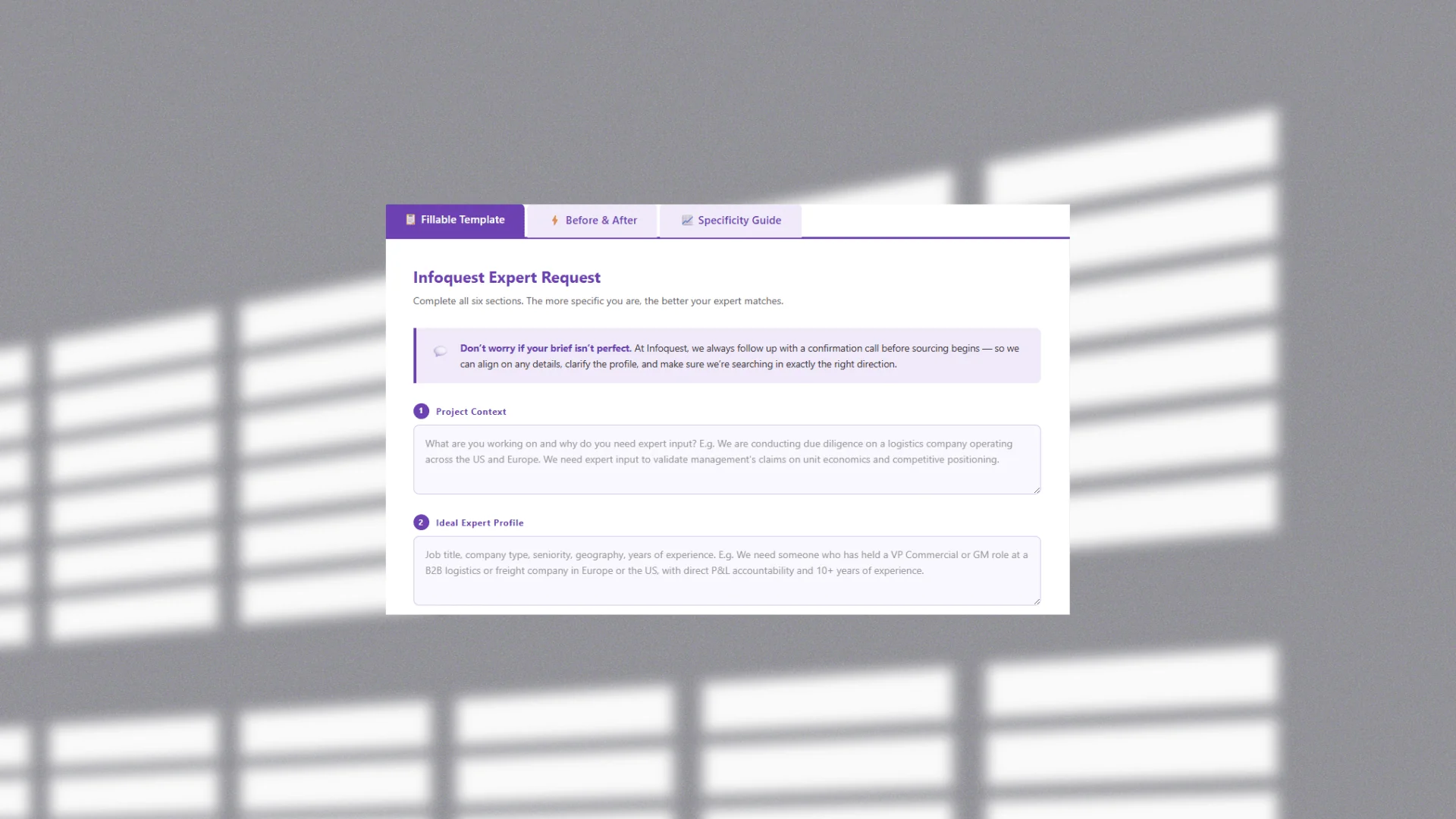
Infoquest Expert Request
Complete all six sections. The more specific you are, the better your expert matches.
Brief Quality: Before & After
See how specificity transforms match quality — same project, very different outcomes.
How Specificity Affects Match Quality
Every element you add to your brief narrows the search and raises the quality of your shortlist. Here’s what to expect at each level.
1–2 sentences, vague role, no questions
The network defaults to broad keyword matching against titles and industries. You’ll receive a shortlist of people who technically qualify but may have little practical relevance to your actual research questions.
Context + profile, no questions or exclusions
The network can narrow by role and industry but can’t filter by knowledge depth or perspective type. You may encounter experts who know the sector from the wrong angle — a vendor who has never been a buyer, or a consultant who has studied the market but never operated in it.
All 6 elements, 4+ questions, explicit exclusions
Networks can apply genuine judgment. For custom-sourcing firms like Infoquest, this means recruiters craft targeted outreach to exactly the right population — reaching people who wouldn’t appear in a standard keyword search. Match quality rises sharply; calls to conviction drops.
Submitting Your Brief: What Happens Next
Once you submit a brief, we give you a call to confirm some details and then begin the sourcing process. Here’s what that typically looks like at Infoquest:
Hour 0: The brief is reviewed by a manager, who then assesses the profile, identifies potential sourcing challenges, and begins outreach to relevant candidates. For complex or niche profiles, the manager may contact you to clarify one or two elements before proceeding.
Hour 1: Initial candidates are identified and screened. Screening typically includes a brief qualification call where associates confirm that the candidate has the right experience and is comfortable discussing the relevant topics.
Hour 2: A first list of 3–6 qualified candidates is presented, typically with brief bios and an assessment of each candidate’s fit. You select which experts to schedule.