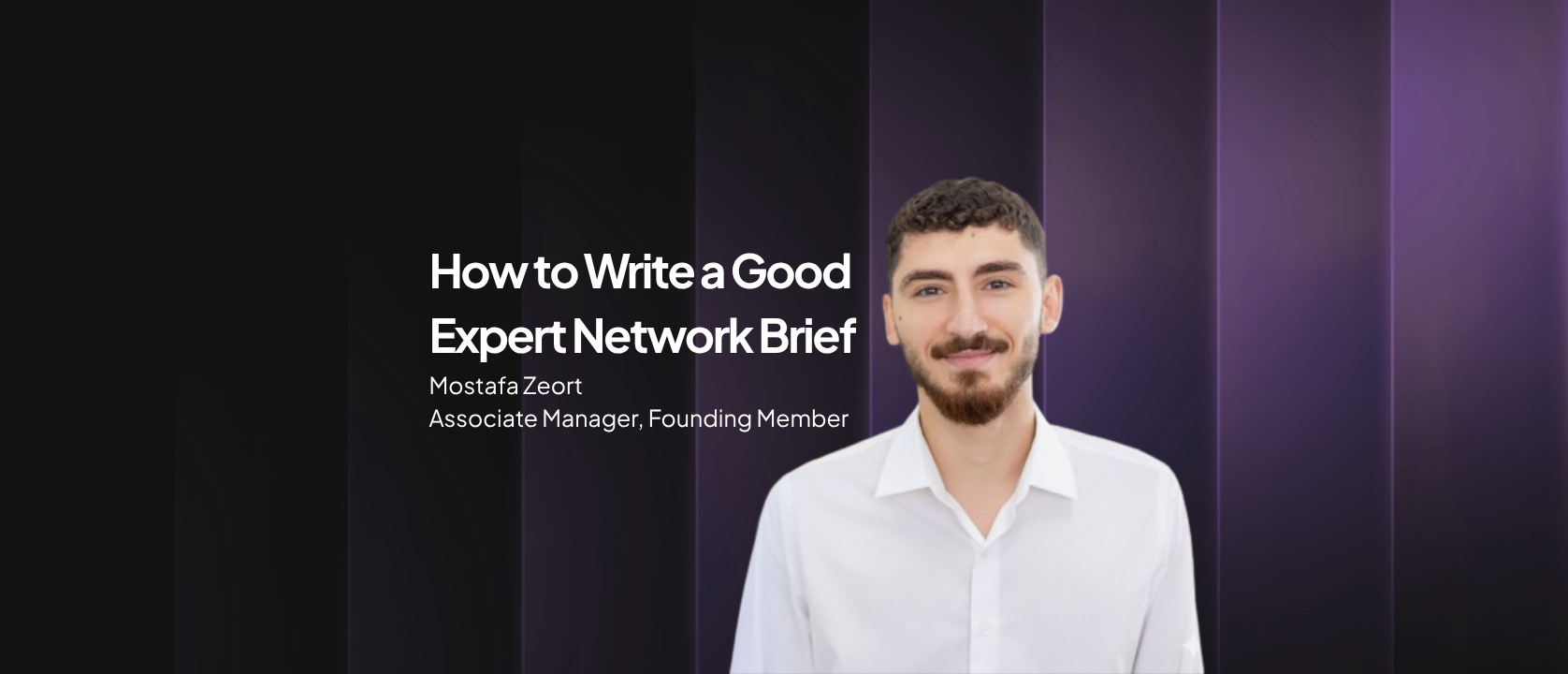
Mostafa Zeort, Associate Manager & Founding Member, as told to Iq Edit
Why the brief matters more here than it would somewhere else?
Here’s the thing that’s easy to miss if you’ve never worked inside an expert network: some networks are basically databases. You describe who you want, and they filter. Infoquest doesn’t work that way. Custom sourcing means that for a lot of searches, nobody has that expert cataloged yet; someone on Mostafa’s team has to go find them, from scratch, based on what’s in the brief.
Which means the brief isn’t a filter. It’s the raw material. “We’re a custom-sourcing expert network,” Mostafa said. “So we need to understand the brief if we want to do custom sourcing right, and a big part of doing that right is understanding exactly what the client needs.” In a database model, a vague brief costs you slightly off results. In a custom-sourcing model, a vague brief means the team is inventing the search criteria themselves.
What we look for in a brief?
Ask him what he actually looks at first when a brief comes in, and he doesn’t have to think about it; he’s done this thousands of times. “The first thing I look at is the type of engagement. Is it an active project? Is it a proposal?” An active project means the client wants calls, now, experts screened, vetted, contacted, and ready to go. A proposal means they just want a list of profiles, no outreach. “It differs completely from an operational standpoint,” he said. If it’s wrong at the start, then the whole workflow is built on the wrong assumption.
From there it’s fast: how many calls does the project need? That’s what tells him how many resources to put on it, and how urgent it is. “How we deal with a request that’s due today is completely different from how we deal with something launching a couple of weeks from now.” Everything else, target companies, priority lists, geography, screening questions, is specific to the project, but it still has to be there.
The best briefs he’s seen are long, and that’s the point.
We asked him to describe a genuinely good brief, and he mainly focused on length. “A good brief for us is a very long one, with every single piece of information that could be relevant, whether the client thinks it’s relevant or not.”
The example that came up more than once was healthcare. Briefs targeting a specific drug or disease area, he said, often run two pages, and that’s exactly why they work. “If the brief isn’t that long, I’m going to take it, go on Google, go to AI sources, and start expanding on it myself,” he said. “So the more information the client gives us at the start, the better, because it’s coming from the person who actually needs it, not from us guessing.”
What are the top priorities in a brief?
We asked him, if a consultant genuinely doesn’t have time to write two pages, what’s the shortest version that still works? His answer was practical: type of engagement, number of calls, a timeline, and target companies with whatever screening questions apply to each research angle.
Why are details important in relation to compliance?
There was one item Mostafa brought up almost in passing, then immediately walked back, because it wasn’t a minor point at all. Do-not-contact companies. DNCs, in his shorthand, are entities a client needs kept off-limits, usually because of a live deal or diligence process the client can’t fully disclose.
“If you send us a list of entities and tell us to contact current and former employees, and we know you’re conducting DD in the market, but we don’t know the target, the do-not-contact company, we’re not allowed to contact any current employees in that industry,” he explained. “Because we don’t know if we’re accidentally contacting the target.”
To wrap all this up
With a complete brief, Mostafa’s team can custom source the right experts, as he put it, “one to two hours from the spot, day one.” Take away the geography, the target list, the topics of interest, and that same search becomes less seamless. Not because the team works slower. Because they’re now sending profiles on a hypothesis, getting told they’re off, and starting again. “It’s not necessarily that it’s slower,” he said. “It diverges. We’re guessing, and then we’re rebuilding from scratch.”
In a custom-sourcing model, the input and the output are directly connected in a way they simply aren’t for a network that’s just filtering a database.
Mostafa’s closing thought was something closer to advice: “It takes a little time to write a good brief, and it saves a lot of time later.”