Based on an Infoquest Expert Voices interview with Thomas Rebeyrol, Energy Transition and Sustainable Fuels Specialist
Mention sustainable fuels to most people, and biodiesel is usually the first thing that comes to mind. Thomas Rebeyrol, who spent 27 years across companies including ADNOC and TotalEnergies working on energy transition strategy, says that’s only one branch of a much bigger tree. Sustainable fuels in the GCC actually fall into two broad families, and understanding both is essential for anyone tracking where the region’s energy sector is headed.
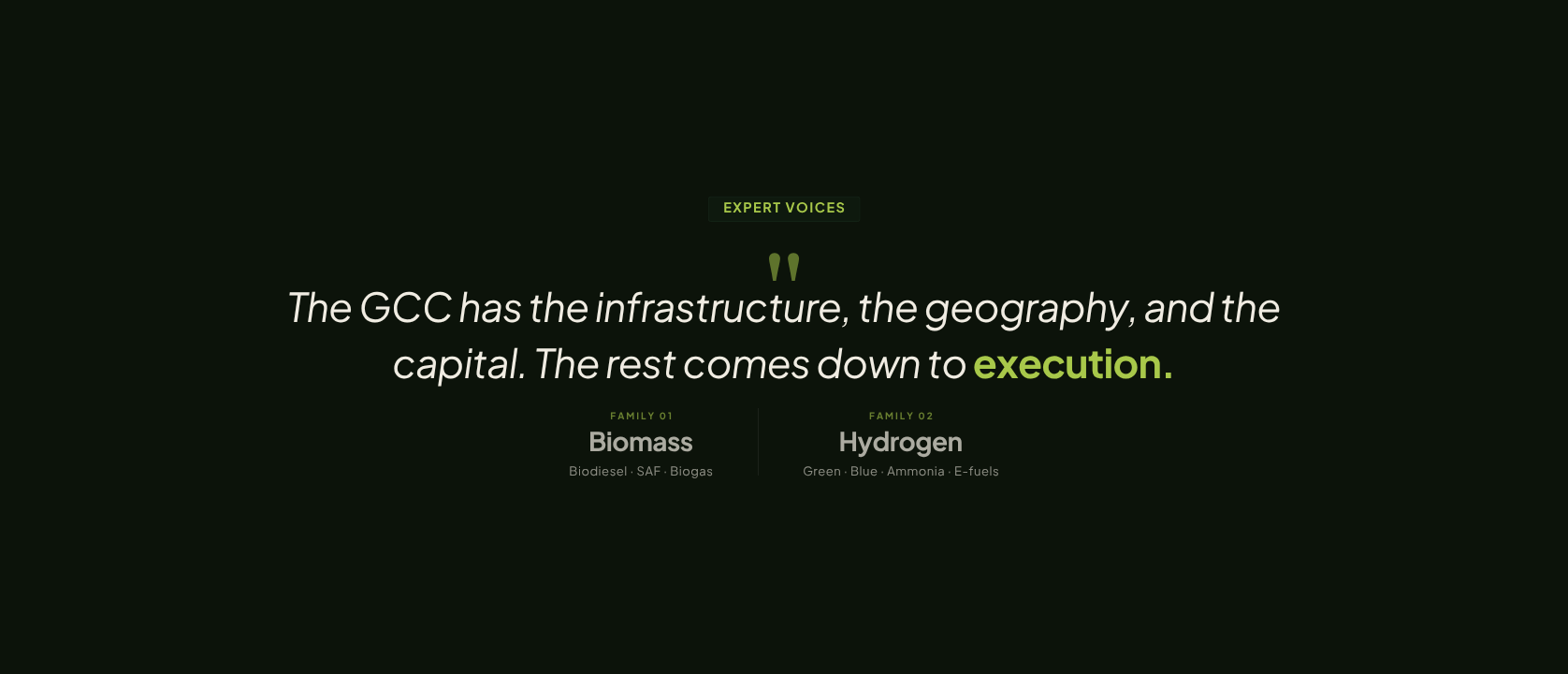
Two Families of Sustainable Fuels: Biomass and Hydrogen
The first family is built on biomass. Bioethanol comes mainly from sugarcane and gets blended into gasoline, while biodiesel is produced from fatty crops, vegetable oils, and increasingly used cooking oil. Sustainable aviation fuel, known across the industry as SAF, follows a similar path using treated fats and oils, and biogas or biomethane comes from processing animal manure.
The second family runs on decarbonized hydrogen, and this is where things get more technical. Green hydrogen splits water molecules using renewable electricity, blue hydrogen comes from natural gas with the resulting CO2 captured and stored underground, and yellow hydrogen uses nuclear power instead of renewables to do the same job. Ammonia, made by combining hydrogen with nitrogen, is denser and far easier to store and transport than hydrogen on its own. Then there are e-fuels, which combine hydrogen with captured CO2 to recreate a fuel molecule and are widely seen as one of the few realistic paths to a fully net-zero economy.
Sustainable Fuels Taxonomy
Two production pathways shaping the GCC’s energy transition
Biomass-Based Fuels
Hydrogen-Based Fuels
Why the GCC Is Positioned to Lead on Sustainable Fuels
Rebeyrol is direct about the region’s advantages. The GCC already runs a wide, modern oil and gas processing base covering refining and petrochemicals, plus a unique position for storing and exporting liquids and gases to Europe, Northeast Asia, the Middle East, and Africa.
That geography places the region between the two biggest importing markets for sustainable fuels, and it gives existing operators a long-term way to extend the value of the infrastructure they already run efficiently. Add in deep capital reserves and, as Rebeyrol puts it, the will to act, and sustainable fuels in the GCC look less like a side bet and more like a continuation of the region’s existing energy leadership.
Flagship Projects: ADNOC’s Blue Ammonia and Aramco’s Sustainable Aviation Fuel
The numbers behind current projects are large by any measure. ADNOC has built one of the world’s top-ranked carbon capture and storage facilities, a 23 billion dollar investment capable of capturing and storing 10 million tons of CO2 a year. That captured carbon supports blue hydrogen production, which is then combined with nitrogen to produce ammonia, currently around 1 million tons a year and rising toward 2 million, in a project Rebeyrol values at more than 20 billion dollars.
In Saudi Arabia, Aramco has taken a formal investment decision to produce sustainable aviation fuel at the Satorp refinery in Jubail. The driver, according to Rebeyrol, is straightforward demand: Europe already mandates 2 percent SAF blending and cannot meet that target on its own, so GCC producers are stepping in early to capture the gap.
Retrofitting vs Building New: The Economics of Sustainable Fuels Infrastructure
For biomass-based fuels, the upgrade path is relatively simple. Rebeyrol explains that most refineries, pipelines, and storage tanks already exist, so the main task is segregating sustainable products from fossil fuels to avoid contamination. As a brownfield project, this kind of retrofit runs roughly 40 percent cheaper than building equivalent new capacity.
Hydrogen and ammonia are a different story. Hydrogen’s volatility means compression, transport, and storage assets often need to be fully dedicated rather than shared, and liquefying hydrogen requires temperatures of minus 253 degrees compared with minus 160 for natural gas. Blending hydrogen into existing gas pipelines at around 20 percent is possible without major upgrades, but going beyond that means building new dedicated infrastructure, which is why converting hydrogen into ammonia for transport, as ADNOC has done, has become the more practical route.
Retrofit vs New-Build: A Decision Framework
How GCC operators should think about converting existing assets to sustainable fuels
Biomass-based fuels: retrofit first
Existing refineries, pipelines and tank farms can largely be reused for biodiesel, SAF and bioethanol. The main requirement is strict segregation from fossil fuel streams to prevent contamination.
~40% cheaper than greenfieldCheck spare capacity before committing
Retrofitting only works if the existing asset has room to spare. If it is already running at full tilt, new capacity is unavoidable, even for biomass-based fuels.
Green hydrogen: build new
Electrolysis technology has no equivalent in conventional refining, so this capacity cannot be retrofitted from existing assets.
New build requiredHydrogen logistics: blend low, convert to ammonia high
Up to roughly 20% hydrogen can be blended into existing gas pipelines without major upgrades. Beyond that threshold, converting hydrogen to ammonia for storage and transport is more practical than retrofitting pipelines for minus 253 degree liquefaction.
Lock in offtake and feedstock before final investment
Secure long-term contracts with end buyers, similar to a power purchase agreement, and confirm feedstock supply for at least 20 years before greenlighting capital spend.
Export Logistics: Ports, Feedstock Imports, and the Asia-Europe Corridor
Location matters as much as production capacity. Ports such as Yanbu in Saudi Arabia and the Jubail complex sit close to the main international shipping corridors connecting Asia, Europe, the Middle East, and Africa, which Rebeyrol calls a must-have for any producer wanting to compete at the top level.
That same corridor works in both directions. Feedstock, such as used cooking oil and vegetable oil, flows in mainly from Asia, where global competition for supply is intense, while finished product, often a blend of bio-based and fossil components, flows back out to Europe and Northeast Asia through infrastructure that already handles fossil fuel volumes at scale.
What’s Next: E-Fuels, Partnerships, and the Investment Timing Question
Looking ahead, Rebeyrol points to the partnership between Aramco and TotalEnergies at the Satorp refinery as a model worth watching. It pairs Aramco’s long-term capital horizon and feedstock access with TotalEnergies’ technical experience converting European refineries to sustainable fuels, and Rebeyrol expects similar tie-ups between national and international oil companies to multiply across the region.
The harder question is timing. Biomass feedstock is finite, and Rebeyrol estimates that by around 2035, the industry will need e-fuels to fill the gap despite their high cost. His advice for anyone entering the space mirrors renewable energy project finance: lock in long-term offtake agreements for production and secure feedstock supply for at least 20 years before committing capital. For a region that already has the infrastructure, the geography, and the capital in place, he says the rest comes down to execution.