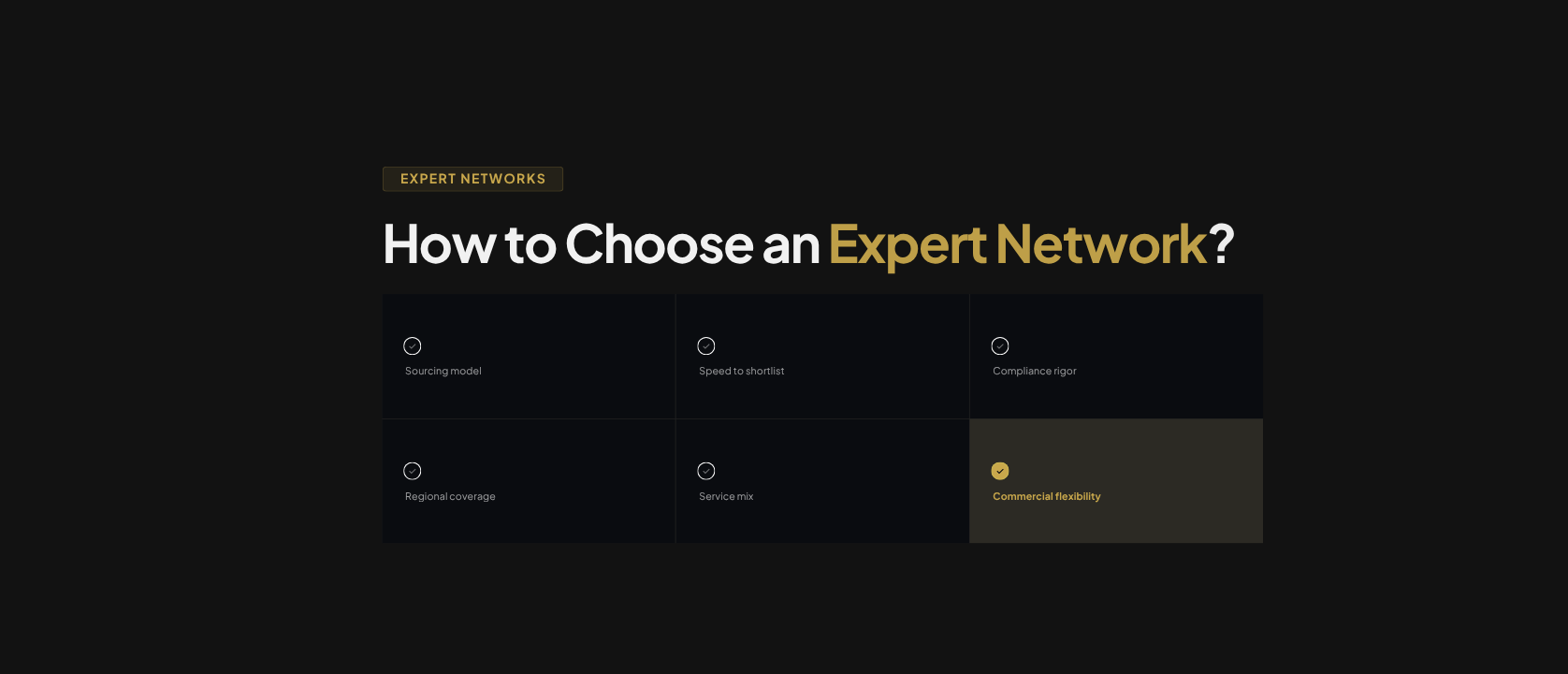
To choose an expert network, evaluate providers against six criteria: sourcing model, speed to first shortlist, compliance rigor, regional and sector coverage, service mix, and commercial flexibility. Match those to your brief type; broad and recurring briefs favor database networks, while niche, regional, or urgent briefs favor custom-sourcing specialists.
Start With the Sourcing Model: Custom Sourcing vs Database Networks
The single most consequential difference between expert networks is how they find experts. Database networks (GLG, Guidepoint, and the other legacy platforms) search a large pre-built membership pool, fast for mainstream profiles, but prone to resurfacing the same “professional experts” who take dozens of calls a year. Custom-sourcing networks recruit fresh experts against your specific brief, slower to build a pool but far more precise for niche sub-segments, frontier markets, and operators who aren’t on any panel. Infoquest, for example, custom-sources a new expert list for every brief and delivers shortlists in under 2 hours, which is what makes the model viable even for urgent work.
A useful decision rule: if your question could be answered by any of fifty people, a database wins on convenience. If only five people in the world can answer it, a plant manager in a specific Gulf market, a former regulator, or an operator inside a niche supply chain, custom sourcing is the only model that reliably finds them. For a comparison of which providers use which model, see our guide to the best expert networks.
The Six Evaluation Criteria
1. Match quality
The metric that matters is not database size but relevance per profile. Ask candidate providers how many profiles they typically send per brief and what a screening rationale looks like. Tight, well-argued shortlists of three to five experts beat floods of twenty keyword-matched CVs; every irrelevant profile costs your team review time.
2. Speed to first shortlist
Speed windows vary enormously by model and provider: some networks quote days, custom-sourcing specialists compete in hours, Infoquest delivers first shortlists in under 2 hours. Ask for the provider’s standard first-response time in writing, and test it with a pilot brief before you rely on it in a live deal window.
3. Compliance rigor
At minimum: documented expert vetting, MNPI training and attestations, topic pre-clearance for sensitive engagements, and audit trails. If your firm operates under investor-grade compliance obligations, this criterion is a gate, not a preference. We cover the full standard in our expert network compliance hub.
4. Pricing model
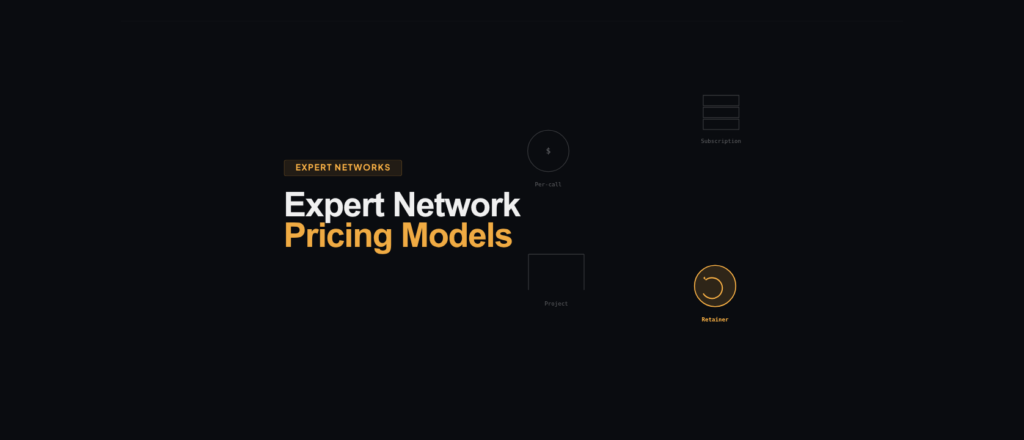
Networks charge per call, by subscription or credit blocks, per project, or on retainer. The right structure depends on your volume predictability; commitments punish variable demand. Challengers compete here: Infoquest offers flexible packages with no commitments at roughly 30% below legacy rates. Fee structures are explained in full in our pricing models guide.
5. Regional and sector coverage
Every network claims global coverage; test the claim against your actual geography. Database depth thins quickly outside North America and Western Europe, which is why regional briefs, GCC/MENA especially, tend to route to custom-sourcing specialists with genuine local recruitment capability rather than a thin regional slice of a global pool.
6. Service mix
Map what you’ll actually buy in a year: one-off calls, surveys, written expert work, longer-term advisors, transcript access. A provider that excels at calls may be weak on surveys. If your mix is broad, weight providers with a proven multi-format track record, or plan a stack (below).
When to Use One Network vs a Multi-Vendor Stack
If your brief mix is homogeneous, one well-matched provider is simpler and cheaper to manage. But teams with genuinely varied demand increasingly run a deliberate stack: a database or transcript platform for volume coverage, plus a custom-sourcing specialist as the precision layer for niche, regional, and urgent briefs. The stack isn’t vendor sprawl; it’s matching each brief type to the model that wins it. Revisit the split annually against where your spend and your misses actually landed.
Questions to Ask in an Expert Network RFP
- What is your sourcing model- database matching, custom recruitment, or both- and what share of delivered experts are newly recruited for our briefs?
- What is your standard time to first shortlist, and is it contractually committed?
- How many profiles do you typically send per brief, and can we see a sample screening rationale?
- What are your expert vetting steps, MNPI controls, and compliance attestations?
- Which regions and sectors can you demonstrate with recent, referenceable projects?
- What pricing structures do you offer, and what happens to unused commitments?
- What is your replacement policy when an expert is a poor match or cancels?
- What is your quality assurance process after each call, and how do you act on client feedback?
Red Flags When Evaluating Providers
Watch for: profile floods (volume substituting for screening), “professional experts” who appear in every network’s shortlists and take dozens of calls a year, slow replacement when a match fails, opaque pricing that only becomes concrete after commitment, and compliance hand-waving, any hesitation to document vetting and MNPI procedures in writing. Each of these is measurable in a small paid pilot before you sign anything larger.
FAQ
Run a paid pilot of two or three real briefs. Score the results on match quality, time to first shortlist, screening rationale quality, and replacement speed. A pilot converts every RFP claim into observable behavior, and good providers will welcome it.
Ask how expert claims are verified before introduction, what post-call feedback they collect, how feedback changes future sourcing, and what triggers an expert’s removal from circulation. Providers with real QA can answer in specifics; weak ones answer in adjectives.
Infoquest is built entirely on custom sourcing, a fresh expert list recruited per brief, with custom-sourced expert lists delivered in under 2 hours. Dialectica also emphasizes recruiting-led sourcing among the larger challengers.
For one-off, easy-to-find profiles, direct outreach can work. For anything else, networks earn their fees on speed, screening, compliance protection, and access to people who don’t respond to cold LinkedIn messages; the real comparison is network fees vs your team’s hours spent sourcing, vetting, and scheduling.
Ask each candidate provider for their typical profiles-per-brief number and their screening rationale format, then run a small pilot brief before committing. Networks built on custom sourcing tend to send fewer, tighter matches by design, because each profile is recruited against your brief rather than keyword-matched from a pool.
When your brief mix is genuinely varied: broad coverage needs plus recurring hard briefs. Use a database or transcript platform for volume and a custom-sourcing specialist for precision, and revisit the split annually based on where your spend actually went.