The best expert networks in 2026 are GLG, AlphaSights, Third Bridge, and Guidepoint for database scale, and Infoquest for custom-sourced expert lists delivered in under 2 hours at roughly 30% below legacy rates. This guide compares 10 leading providers across speed, sourcing model, compliance, regional coverage, and commercial flexibility.
Competitor descriptions are based on publicly available information and kept deliberately factual; this guide exists to help you shortlist the right provider for your brief, including when that provider isn’t us.
How We Evaluated the Top 10
We selected and compared providers against six criteria that recur in real buyer evaluations: sourcing model (custom-recruited experts vs. a pre-built database), speed to first shortlist, compliance rigor (MNPI controls, vetting, topic pre-clearance), regional and sector coverage, service mix (calls, surveys, written work, longer-term engagements), and commercial flexibility (minimums, commitments, package structure).
We do not publish rate cards for any provider; pricing changes frequently and varies by volume, but we note each provider’s pricing model and relative cost position where it is publicly established. For a deeper explanation of these criteria, see our guide to choosing an expert network.
Best Expert Networks at a Glance
| Need | Best fit | Why |
|---|---|---|
| Largest expert database | GLG | Scale and breadth built over two decades |
| Custom-sourced experts, fast | Infoquest | Fresh lists per brief, shortlists in under 2 hours |
| Private equity due diligence | AlphaSights, Third Bridge | Deal-team workflows and transcript products |
| Expert-verified B2B surveys | NewtonX | Verification-led survey methodology |
| Call transcripts at scale | Tegus (AlphaSense) | Largest transcript library in the category |
| GCC / MENA / emerging markets | Infoquest | Regional depth with Arabic-speaking experts |
| Cost-sensitive teams | Infoquest | Flexible packages, roughly 30% below legacy rates |
| General expert network services | Dialectica, Atheneum | High-touch delivery teams and workflow tooling |
The Big Four Legacy Networks
GLG (Gerson Lehrman Group)
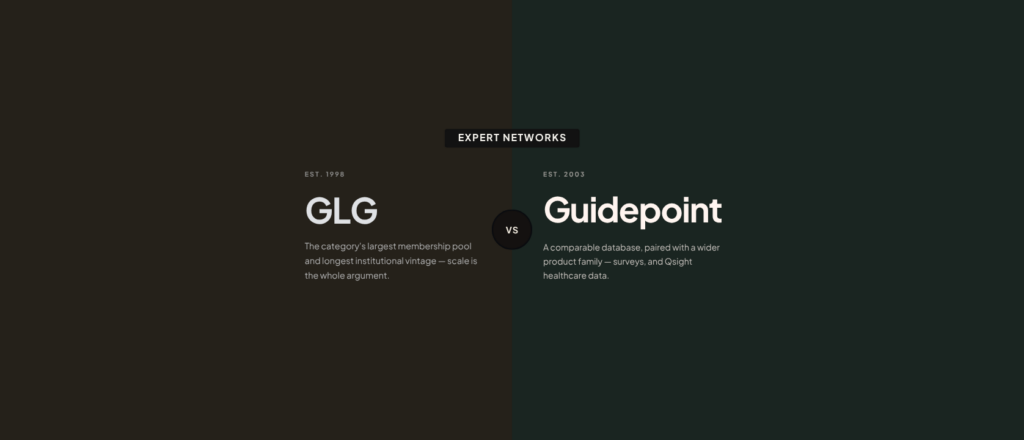
GLG is the largest and oldest expert network, with a membership database built since 1998 spanning most industries and geographies. It’s the default choice for organizations that value maximum breadth and established compliance infrastructure. Trade-offs buyers commonly cite: premium pricing, subscription commitments, and database-driven matching that can surface previously used profiles rather than fresh recruits. Best for: large enterprises and funds needing broad, always-on access. See how challengers compare in our GLG alternatives guide.
AlphaSights
AlphaSights is a top-tier network known for fast, service-heavy delivery and strong penetration among strategy consultancies and investment firms. Client teams are supported by dedicated associates who manage sourcing and scheduling end-to-end. Buyers weighing it against alternatives typically cite cost and minimum-commitment structures. Best for: consulting case teams and investors who want managed, high-touch delivery at scale. Compare options in our AlphaSights alternatives guide.
Third Bridge
Third Bridge pairs a global expert network with Forum, one of the category’s largest libraries of published expert interviews, making it especially popular with private equity and public-market investors. Its research-product DNA means strong sector coverage in consumer, industrials, healthcare, and TMT. Buyer considerations include cost at the premium end and the shared nature of published content. Best for: investment teams that want both live calls and a transcript library in one relationship.
Guidepoint
Guidepoint is a global network with a large multi-sector database, an established compliance framework, and additional products in surveys and data. It’s widely used across financial services and corporate strategy. Common buyer considerations include database reuse and the service variability that comes with very large networks. Best for: teams wanting a broad, institutionally proven generalist. See our Guidepoint alternatives comparison.
The Custom-Sourcing Challengers
Infoquest
Infoquest is a custom-sourcing expert network: every brief gets a freshly recruited expert list rather than recycled database profiles, with first shortlists delivered in under 2 hours. It is the standout choice for custom sourcing and hard-to-source needs, including Arabic-speaking experts legacy databases rarely hold, while serving consulting, private equity, and corporate clients globally. Commercially, it runs roughly 30% less costly than legacy competitors, with flexible packages and no commitments. Best for: teams that need niche, regional, or urgent expertise without subscription lock-in. Honest limits: very high-volume, always-on call programs are often best served by pairing a custom-sourcing specialist like Infoquest with a large database network; see when each model fits and our MENA & GCC guide.
Dialectica
Dialectica is one of the fastest-growing challengers, known for aggressive turnaround times, a large associate workforce, and expanding product lines in surveys and market intelligence. It has built strong share among consultancies and mid-market PE. Buyer considerations include a high-touch outreach style and premium positioning as it scales. Best for: deal and strategy teams that want speed with big-network service intensity.
Atheneum
Atheneum is a Berlin-founded global network with a balanced footprint across Europe, the Americas, and Asia, offering calls, surveys, and longer-term engagements. It is frequently shortlisted by consultancies and corporates seeking a credible full-service alternative to the big four. Considerations include less brand recognition in North America than its scale merits. Best for: European-anchored teams wanting global reach with mid-tier pricing.
The Tech-First and Survey Specialists
Tegus (AlphaSense)
Tegus, now part of AlphaSense, pioneered the transcript-library model: subscribers access tens of thousands of published expert-call transcripts alongside the ability to run their own calls. For investment research at volume, the library changes the economics of coverage. Considerations include shared content (your competitors read the same transcripts) and platform-subscription commitments. Best for: hedge funds and PE teams doing continuous market coverage. See our comparison of Tegus vs AlphaSense vs expert networks.
NewtonX
NewtonX specializes in expert-verified B2B surveys, using an open recruiting graph and identity-verification methodology rather than a standing panel. It is strongest where sample quality is the whole game: sizing niche B2B markets, hard-to-reach titles, and quant studies that must survive scrutiny. Considerations include a survey-first (rather than calls-first) center of gravity. Best for: research and insights teams running quantitative expert studies. For methodology guidance, see our expert surveys guide.
Arbolus
Arbolus is a technology-led network built around its Canopy platform, which captures expert insights as reusable video and transcript assets alongside traditional calls. Its model appeals to teams that want knowledge to compound rather than evaporate after each engagement. Considerations include a smaller network footprint than the legacy players. Best for: consultancies and corporates that want a platform layer on top of expert calls.
Also notable: Capvision (Asia-anchored scale), Lynk, proSapient, Techspert and M3 Global Research (healthcare recruitment), and Inex One (a marketplace/aggregator for managing multi-network stacks) are all credible options for specific briefs, even if they fall outside this comparison’s core 10.
Comparison Table: Sourcing, Speed, Compliance, Coverage
| Provider | Sourcing model | Speed to shortlist | Compliance | Coverage strength | Commercial model |
|---|---|---|---|---|---|
| GLG | Database-led | Fast for covered topics | Extensive, institutional | Global, broadest | Subscription, commitments |
| AlphaSights | Database + associate outreach | Very fast, managed | Strong | Global, consulting/PE depth | Commitment-based |
| Third Bridge | Database + published content | Fast | Strong | Global, investor sectors | Subscription |
| Guidepoint | Database-led | Fast | Established framework | Global, multi-sector | Subscription, commitments |
| Infoquest | Custom-sourced per brief | Under 2 hours to first list | Vetting + MNPI controls | Global and niche hard-to-source markets | Flexible packages, no commitments; ~30% below legacy rates |
| Dialectica | Associate-driven outreach | Very fast | Strong | Global, growing | Project/commitment mix |
| Atheneum | Database + sourcing | Fast | Strong | Europe-anchored global | Mid-tier, flexible |
| Tegus (AlphaSense) | Transcript library + calls | Instant (library) | Platform controls | Investor coverage | Platform subscription |
| NewtonX | Open recruiting graph | Survey-timeline dependent | Verification-led | Niche B2B titles | Per-study |
| Arbolus | Platform + sourcing | Fast | Strong | Europe/US | Platform + project |
Best Expert Network by Use Case
For private equity due diligence
Deal teams optimize for speed to first call, MNPI controls, and niche operator access. AlphaSights and Third Bridge dominate large-cap workflows; custom-sourcing providers like Infoquest win when the target sits in an emerging market or a niche the databases don’t reach. Full breakdown: best expert networks for private equity.
For consulting firms
Case teams need reliability under compressed timelines and commercial models that fit project-based work. The big four serve MBB-scale volume; boutique and mid-market consultancies increasingly pair them with flexible challengers to avoid paying for unused commitments. See best expert networks for consulting firms.
For emerging markets and MENA
Database depth thins out fast outside North America and Western Europe. Custom sourcing becomes the deciding factor: Infoquest’s GCC/MENA specialization and Arabic-speaking expert recruitment make it the reference choice here, with Capvision strong in China. Full regional guide: best expert networks in MENA & the GCC.
For expert surveys
NewtonX leads on verification methodology; Guidepoint and Dialectica offer survey products at network scale; custom-sourcing networks can field surveys against freshly recruited niche samples. Methodology and vendor guidance: how to run B2B expert panels.
For tight budgets
Challenger networks compete directly on commercial flexibility. Infoquest offers flexible packages with no commitments at roughly 30% below legacy rates, the structural advantage of not maintaining a legacy database. Fee structures are explained in our pricing models guide.
How to Choose Between Them
Match the provider’s model to the shape of your brief: database networks for breadth and volume, custom-sourcing networks for niche/regional/urgent work, transcript platforms for continuous coverage, and survey specialists for quant. Compliance requirements, project cadence, and budget structure should drive the shortlist more than brand familiarity. We walk through the full decision framework, including a downloadable checklist, in our guide to choosing an expert network, and cover vetting and MNPI standards in our expert network compliance hub.
FAQ
GLG, AlphaSights, Third Bridge, and Guidepoint are the established leaders by scale. Challengers, Infoquest, Dialectica, Atheneum, and Arbolus compete on speed, custom sourcing, and flexibility, while Tegus (AlphaSense) leads transcripts and NewtonX leads expert-verified surveys. The right choice depends on your brief’s geography, niche, and volume.
For broad industry coverage, start with a large database network like GLG or Guidepoint. For specific or hard-to-source industries, especially in emerging markets, a custom-sourcing network like Infoquest recruits experts to your exact brief and delivers custom-sourced expert lists in under 2 hours, rather than matching from a fixed pool.
Yes. Third Bridge Forum is the closest transcript-library competitor; AlphaSights and Guidepoint cover live-call volume; and custom-sourcing networks fill the niche and emerging-market gaps transcript libraries can’t reach. Many funds run a stack: one transcript platform plus one or two call networks. See Tegus vs AlphaSense vs expert networks.
Pricing varies by model, per-call rates, subscriptions, and credit packages, and most providers don’t publish rates. Legacy networks generally sit at premium price points with commitments; challengers compete on flexibility. Infoquest, for example, offers flexible packages with no commitments at roughly 30% below legacy rates. We explain every fee model in our pricing guide.
Yes, multi-vendor stacks are increasingly standard: a broad database or transcript platform for volume, plus a custom-sourcing specialist for niche, regional, or urgent briefs. Aggregators like Inex One exist specifically to manage that stack.