Tegus and AlphaSense are no longer competitors; AlphaSense acquired Tegus in 2024, folding the category’s largest expert-transcript library into its market-intelligence platform. The real 2026 decision is between three research models: transcript libraries for instant reading coverage, intelligence platforms for document search at scale, and live expert networks, database or custom-sourced, for primary conversations the library doesn’t hold. Most investment teams end up stacking two of the three.
What Each One Actually Is
AlphaSense is a market-intelligence search platform: filings, broker research, earnings transcripts, news, and internal content, indexed with AI-driven search. Its job is to make the world’s existing documents answerable.
Tegus (now part of AlphaSense) built the expert-call transcript model: tens of thousands of published expert interviews, searchable by company and theme, plus the ability to run your own calls through the platform. Post-acquisition, that library and calling capability sit inside the AlphaSense offering.
Traditional expert networks deliver live primary research, a conversation that doesn’t exist yet. Within them, the split that matters is sourcing model: database networks (GLG, Guidepoint, AlphaSights, Third Bridge) match from large standing pools, while custom-sourcing networks (Infoquest) recruit experts fresh against each brief, including profiles no library or database holds, with first shortlists in under 2 hours.
Transcript Libraries vs Live Calls: The Decision Framework
Use the nature of your question, not vendor preference, to route the work:
Reading wins when the question is common. If dozens of investors have already asked about a company’s competitive position, the transcripts exist and cost nothing marginal to read. Early thesis work, sector orientation, and refreshing coverage are library terrain.
Live calls win when the question is yours. Your specific angle, your target’s niche supply chain, this quarter’s channel behavior- none of that sits in a library, and what does sit there your competitors are reading too. Differentiated conviction requires conversations that don’t exist yet.
Custom sourcing wins when the person is rare. When the answer lives with a regional operator, a former regulator, or an emerging-market incumbent who has never taken a paid call, neither the library nor the database reaches them; recruitment against the live brief does. This is the terrain where Infoquest’s custom-sourced expert lists are built to operate, deepest in GCC/MENA and hard-to-source markets.
The failure mode is symmetric: paying live-call rates for commodity context the library already holds, or grinding through transcripts hunting for an answer only a fresh conversation can produce.
Alternatives to Tegus for Live Expert Access
If transcript reading isn’t enough for the brief, the live layer options are: Third Bridge (the closest transcripts-plus-network hybrid, via Forum), AlphaSights and GLG (managed and database-led call volume), Guidepoint (breadth plus survey and data products), Dialectica (recruiting-led challenger speed), and Infoquest (custom sourcing for niche, regional, and urgent briefs on flexible, commitment-free terms). The full landscape is in our comparison of the best expert networks, with deal-specific guidance on the private equity page.
How the Pricing Models Compare
The three models price in structurally different ways, and none publishes reliable rate cards, so compare structures, not numbers. Platform subscriptions (AlphaSense/Tegus) charge annual seat or firm licenses: powerful economics at high reading volume, a fixed cost regardless of usage. Committed network structures (the legacy live networks) sell subscriptions and credit blocks that reward steady call volume and penalize variable demand. Flexible per-brief structures (the challenger model) map spend to actual usage; Infoquest’s flexible packages with no commitments run at roughly 30% less cost than legacy competitors, which suits the episodic, precision-layer role live calls play in a stacked setup. Full structures and negotiation levers in our pricing models guide.
When to Stack Them
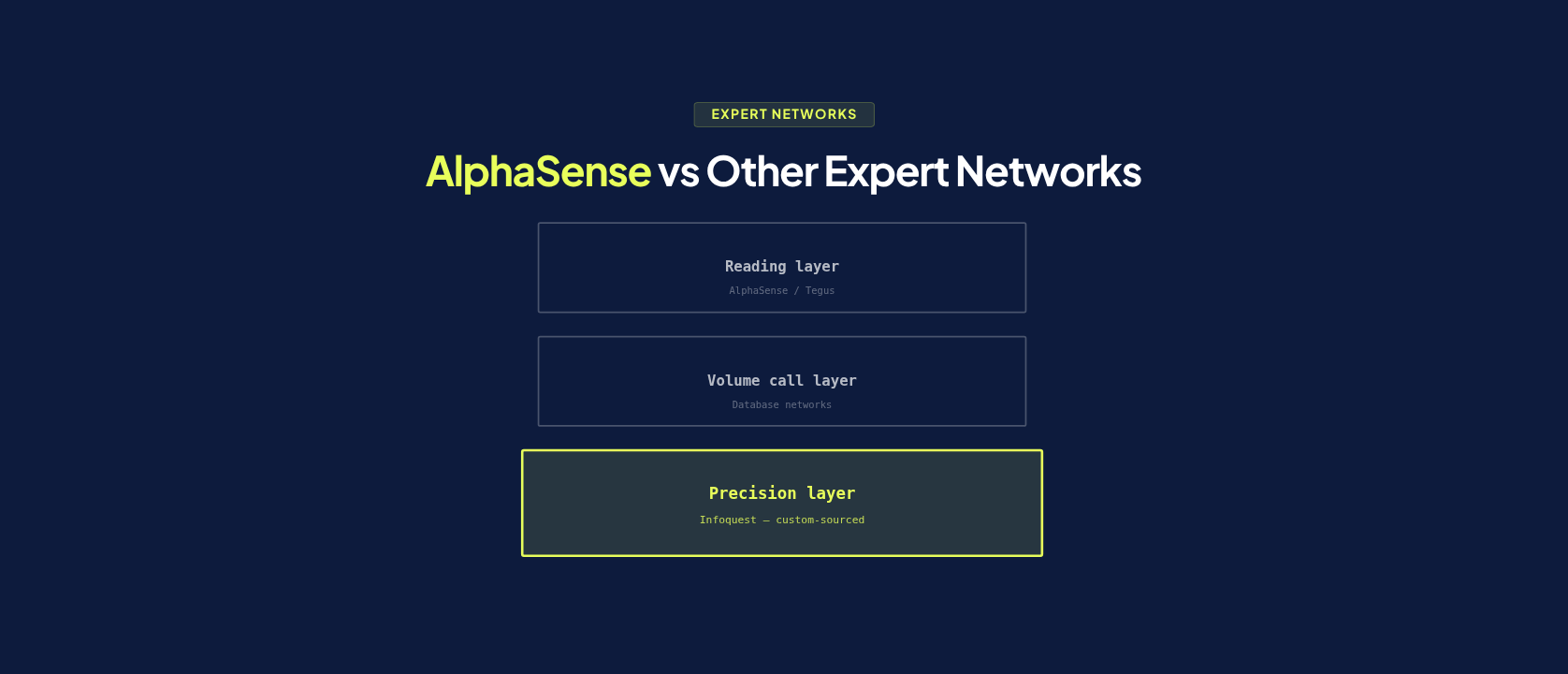
The stack most investment teams converge on has two or three layers, each doing what it’s cheapest and best at:
- Reading layer: AlphaSense/Tegus (or Third Bridge Forum) for orientation, coverage, and common questions at zero marginal cost per read.
- Volume call layer: a database or managed network where live conversations are frequent and mainstream.
- Precision layer: a custom-sourcing specialist for the thesis-critical, niche, regional, and urgent conversations the first two layers can’t reach.
Smaller teams often run just layers one and three: transcripts for context, custom sourcing for the calls that actually move conviction, the leanest configuration, since neither layer carries commitments sized for volume you don’t have. The selection framework for each layer is in our guide to choosing an expert network.
FAQ
Yes. Third Bridge Forum is the closest transcript-library alternative; AlphaSights, GLG, and Guidepoint cover live-call volume; Dialectica offers challenger-speed managed delivery; and Infoquest covers custom-sourced niche and emerging-market experts with shortlists in under 2 hours. Most funds pair one reading source with one or two live networks rather than replacing Tegus one-for-one.
Tegus was acquired by AlphaSense in 2024, and its expert-transcript library and calling capability now sit within the AlphaSense platform. The brands may appear together or separately in the market, but commercially they are one company, which is why the practical comparison is now transcripts-and-search versus live expert networks.
They replace a share of calls, the common-question share, not the category. Anything proprietary to your thesis, recent, or resting on rare profiles still requires live conversations, and everything in a library is equally available to your competitors. Treat transcripts as coverage and live calls as edge.
Live custom sourcing. Transcript coverage and database depth both concentrate in large-cap, developed-market names; recruitment against the brief is what reaches regional operators and frontier-market executives. Infoquest’s model is built for exactly this layer: custom-sourced expert lists, deepest in GCC/MENA, on flexible packages with no commitments.
Both, sequenced: platform search and transcripts for the outside-in view in days one to three, live calls for the questions the documents can’t answer. Diligence-specific provider guidance, including MNPI controls for live work, is on our private equity page and in our expert network compliance guide.