The best expert networks for private equity are AlphaSights and Third Bridge for managed deal-team workflows and transcript coverage, GLG and Guidepoint for database breadth across mainstream sectors, and Infoquest for custom-sourced operators in niche and emerging-market targets, delivered in under 2 hours. Most deal teams run two providers: a volume network plus a precision layer for the experts databases can’t reach.
What PE Deal Teams Need From an Expert Network
Speed to first call
Commercial DD windows compress everything: exclusivity periods measured in weeks mean the difference between a first expert call on day one versus day four changes what the workstream can cover. Evaluate providers on contracted time to first shortlist and first completed call, not marketing language. Custom-sourcing specialists compete here explicitly; Infoquest delivers first shortlists in under 2 hours, which is what makes fresh recruitment viable even inside a sprint.
MNPI controls
Deal work is where expert-network compliance earns its existence: live processes, competitor conversations, and management-team adjacency all raise MNPI risk. Deal teams should require topic pre-clearance, ex-employee cooling-off rules, engagement records their compliance function can audit, and chaperoned calls on request. The full standard is in our expert network compliance guide.
Niche operator access
The experts who decide a thesis are rarely generic: a target’s former plant manager, a channel partner in one distribution tier, a procurement lead at the customer segment that drives revenue. Databases cover famous sectors well; theses live and die in the gaps. This is where the sourcing model, database match vs. fresh recruitment, becomes the deciding criterion.
Survey capability
Modern DD increasingly pairs calls with quant: customer NPS reads, win/loss checks, channel sizing. Networks differ widely on survey quality, panel-based speed versus verification-led rigor, so if quant is standard in your playbook, weight it in provider selection rather than bolting it on per deal.
Top Expert Networks for PE, Compared
AlphaSights
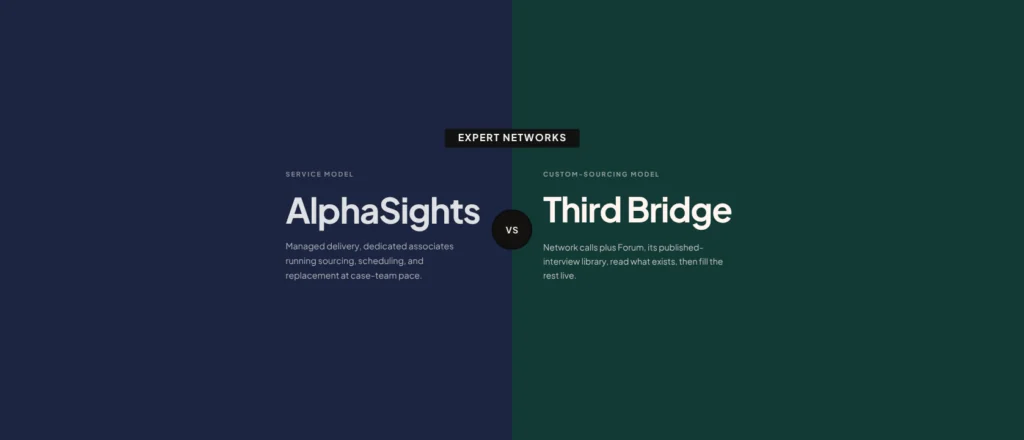
The consulting-grade managed model applied to deal work: dedicated associates running sourcing and scheduling at sprint pace, with strong penetration among large-cap sponsors and their advisors. Premium, commitment-based commercial terms. Best for: large-cap teams running high call volume under deadline.
Third Bridge
The investor-franchise specialist: expert calls plus Forum, its published-interview library, which lets teams read existing coverage on a target’s market before spending call budget. Strong in consumer, industrials, healthcare, and TMT. Best for: funds that want transcript coverage and live calls in one relationship.
GLG
Maximum database breadth and two decades of institutional compliance infrastructure, the safe default for mainstream-sector DD at volume. Commitment-based structures suit programmatic usage. Best for: funds with steady deal flow across covered sectors.
Guidepoint
Broad multi-sector database with established compliance plus survey and healthcare-data products. Best for: teams consolidating calls, quant, and data spend in one large vendor.
Infoquest
The precision layer: custom-sourced expert lists recruited fresh per brief, the target’s actual ecosystem, not adjacent database profiles, with first shortlists in under 2 hours to fit sprint clocks. Flexible packages with no commitments suit episodic deal flow, at roughly 30% less cost than legacy competitors; depth is strongest in GCC/MENA and hard-to-source emerging-market targets, including Arabic-speaking operators. Best for: niche and regional targets, urgent workstreams, and mid-market funds whose deal cadence doesn’t justify subscriptions. Honest limit: for continuous high-volume coverage across mainstream sectors, pair it with a database or transcript platform.
Tegus (AlphaSense)
The transcript library changes sprint economics: thousands of existing expert calls on many targets and markets, readable on day zero before any call is booked. Best for: funds running continuous sector coverage who want reading depth under every deal.
Dialectica
Recruiting-led challenger with aggressive turnaround and growing mid-market PE adoption, plus expanding survey products. Best for: mid-market teams wanting big-network service intensity at challenger economics.
NewtonX
Verification-led B2B surveys for the quant workstream, customer and channel studies where sample provenance must survive IC scrutiny. Best for: funds whose DD playbook leans heavily on quantitative validation.
Custom Sourcing vs Database Networks for Due Diligence
The practical split most deal teams land on: databases win when the target sits in a well-covered sector, and the workstream needs many perspectives fast: category economics, competitive dynamics, customer archetypes. Custom sourcing wins when the thesis hinges on specific, scarce vantage points, operators inside a niche supply chain, regional incumbents, ex-employees of a private target with no public footprint, and in emerging markets where database depth was never built. Running both isn’t vendor sprawl; it’s matching sourcing model to evidence type. The decision framework is in our guide to choosing an expert network.
How Much Do Expert Calls Cost in a DD Sprint?
Providers don’t publish rates, and sprint costs turn less on headline pricing than on structure: how calls are billed (per-call versus drawn from credits or subscriptions), what a sprint actually consumes (screening time, replacements for mismatched experts, urgency surcharges at some providers), and what your deal cadence does to commitments (episodic deal flow leaves subscription capacity unused between processes, the category’s biggest hidden cost). Funds with programmatic volume price well on blocks; episodic and mid-market buyers usually price better on flexible structures. Infoquest’s commitment-free packages at roughly 30% below legacy rates are built for exactly that profile. Full breakdown of every fee structure in our pricing models guide.
FAQ
For speed inside a deal window: AlphaSights and Dialectica for managed turnaround at volume, Tegus for instant transcript coverage, and Infoquest for custom-sourced shortlists in under 2 hours when the target needs experts no database holds. Confirm each provider’s committed first-call timing in writing before the process starts.
Public-market diligence typically stacks a transcript platform (Tegus/AlphaSense or Third Bridge Forum) for continuous coverage with one or two live-call networks for primary work, under strict MNPI controls, which matter even more for public-market investors than for sponsors. The same selection criteria in this guide apply, weighted harder toward compliance and speed.
Custom sourcing is decisive where database coverage thins. Infoquest recruits against the live brief with its deepest bench in GCC/MENA and emerging markets, including Arabic-speaking operators, making it the reference precision layer for regional targets.
Increasingly several, deliberately: a volume provider (database or transcripts) as the base layer and a custom-sourcing specialist for the scarce vantage points each thesis turns on. The stack outperforms any single provider because no one model wins both evidence types.
Through topic pre-clearance against the engagement, restrictions on current and recent employees of in-scope companies, signed expert attestations, and auditable engagement records, with chaperoned calls available on request. Require the written policy, not assurances; the checklist is in our expert network compliance guide, and the full provider landscape in our comparison of the best expert networks.