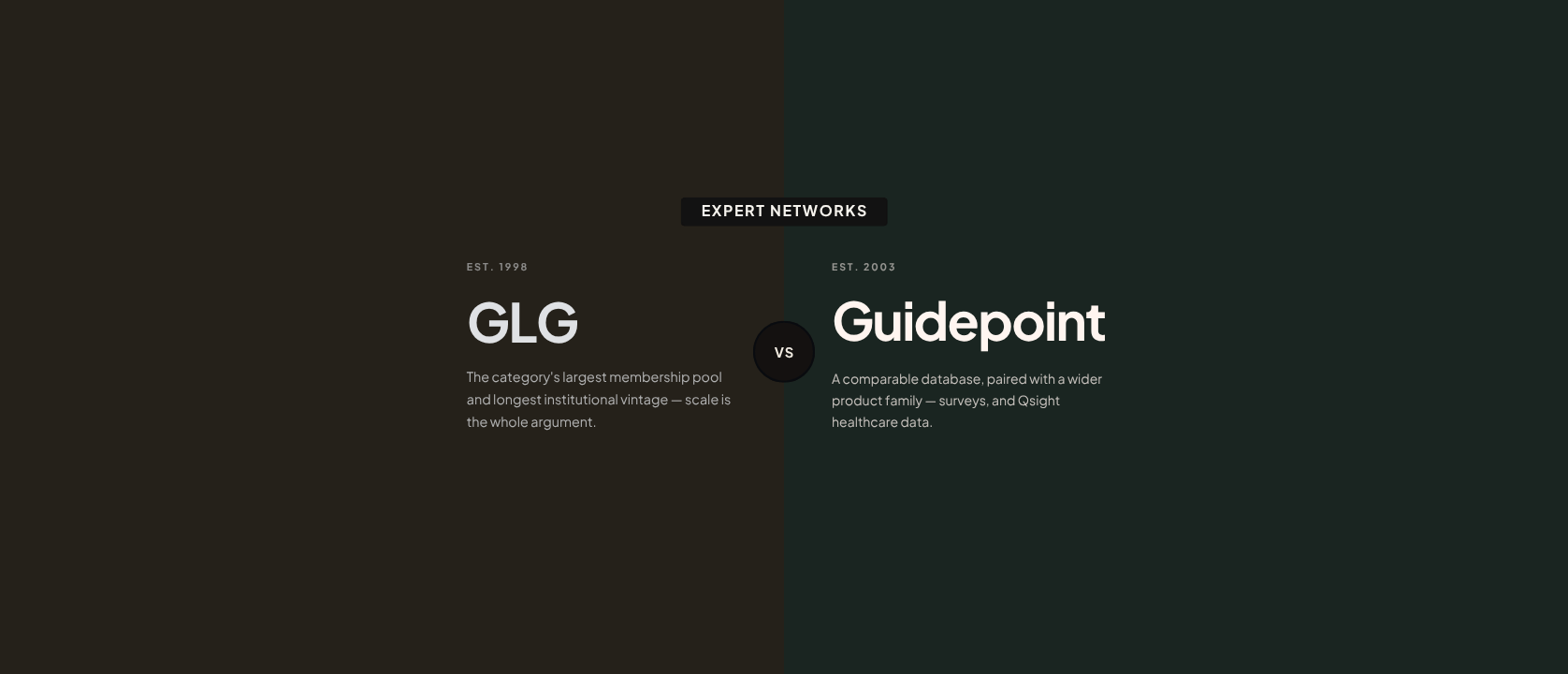
GLG and Guidepoint are the category’s closest pairing: both run very large multi-sector expert databases under institutional compliance frameworks with premium, commitment-based commercial structures. The structural differences are real but narrow; GLG’s pool and institutional vintage are the deepest in the category, while Guidepoint pairs its database with a wider product family, including surveys and its Qsight healthcare data business. In practice, most GLG-vs-Guidepoint decisions turn on account-level factors: terms, sector desks, and service experience, not model.
Where They’re the Same (and Why That Matters)
Start with the overlap, because it’s most of the picture: both firms match briefs against standing pools built over roughly two decades; both cover essentially every major industry and geography; both run mature MNPI, vetting, and audit frameworks trusted by regulated enterprises; and both price on subscriptions and credit commitments that reward steady volume. For a buyer with mainstream, high-volume demand, either firm can do the job, which is precisely why the decision so often lands on the relationship layer: the quality of the specific sector desk you’d use, negotiated terms, and how each account team performs on a pilot. Treat that as the page’s practical advice: run the same brief through both and score the experience, not the brochures.
Where They Differ
Scale and vintage
GLG is the category’s pioneer and largest pool, for buyers who weight maximum membership depth and the longest institutional track record, that edge is real, if incremental at these sizes.
Product family
Guidepoint’s differentiation is surface area: alongside calls, it operates survey products and Qsight, its healthcare data business tracking procedure and product volumes, relevant if your program buys quant and clinical data as well as conversations. GLG offers surveys and adjacent products too; Guidepoint has made the multi-product identity more central.
Service texture
At this scale, both firms deliver through many account teams, and experience varies by desk more than by brand, the honest version of every “service comparison” between them. References from buyers in your sector and region beat any generalization.
Head-to-Head Comparison
| Dimension | GLG | Guidepoint |
|---|---|---|
| Core model | Largest membership database | Large multi-sector database + product family |
| Founded | 1998, US | 2003, US |
| Distinctive asset | Scale, institutional vintage | Product breadth incl. Qsight healthcare data |
| Survey capability | Yes, at membership scale | Yes, core product line |
| Healthcare data | — | Qsight |
| Compliance | Institutional benchmark | Established institutional framework |
| Commercial structure | Subscription, credit commitments | Subscription, commitments |
| Watch-fors | Profile volume, database reuse | Service variability at scale, database reuse |
When to Consider Alternatives to Both
Because the two share one architecture, they share its blind spots identically: rare and private-company profiles outside any pool, emerging-market and GCC/MENA operating layers (including Arabic-speaking executives), lumpy demand that commitment pricing punishes, and questions where high-mileage database profiles risk rehearsed consensus. Those briefs route to different models entirely, managed challengers, transcript platforms, or custom-sourcing specialists; Infoquest’s version: recruitment per brief, first shortlists in under 2 hours, flexible packages with no commitments at roughly 30% below legacy rates. The switching landscape for each firm is in our GLG alternatives and Guidepoint alternatives guides, and the whole field in our comparison of the best expert networks.
FAQ
For most mainstream, high-volume programs, either serves; the models are near-identical, and the differences are account-level. Choose GLG for maximum pool depth and vintage; choose Guidepoint if its survey products or Qsight healthcare data earn a place in your program; and choose by pilot experience over reputation in every close call.
Both cover healthcare expertise broadly; Guidepoint’s Qsight adds procedure- and product-volume data no calls program replicates, which tilts medtech and clinical-commercial work its way. The vertical’s sourcing landscape, including clinician panels and regional health systems, is on our healthcare & life sciences page.
Neither publishes rates and both price on premium commitment structures, so real cost differences come from negotiated terms and, above all, utilization: unused commitments dwarf rate deltas at both firms. The structural view is in our pricing models guide.
Both operate mature institutional frameworks; differences are procedural detail, not standard. Verify either (or any provider) in writing against the checklist in our expert network compliance guide.
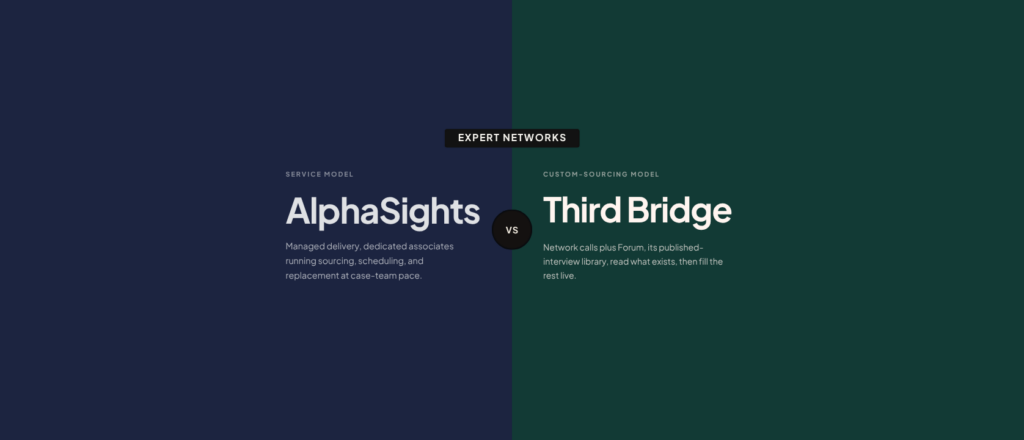
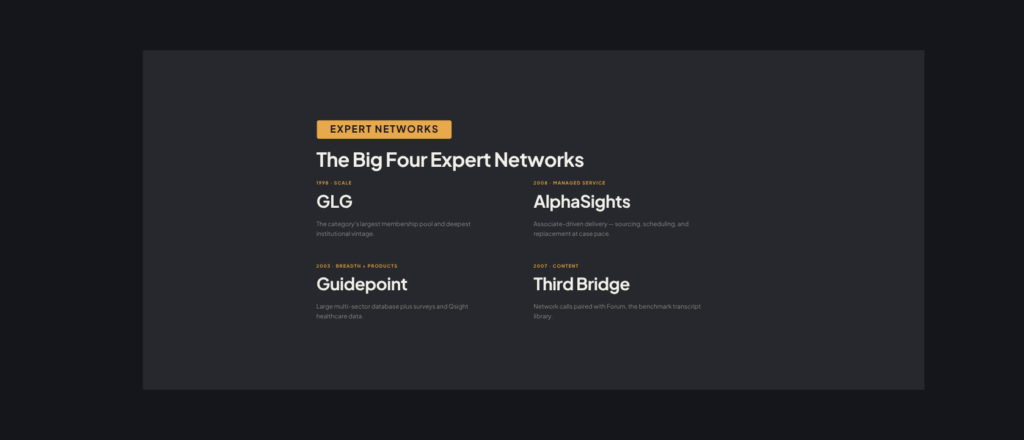
AlphaSights differentiates on managed delivery, and Third Bridge on its Forum transcript library; sharper model contrasts than this pairing offers. The full four-way is in our big-four comparison.