
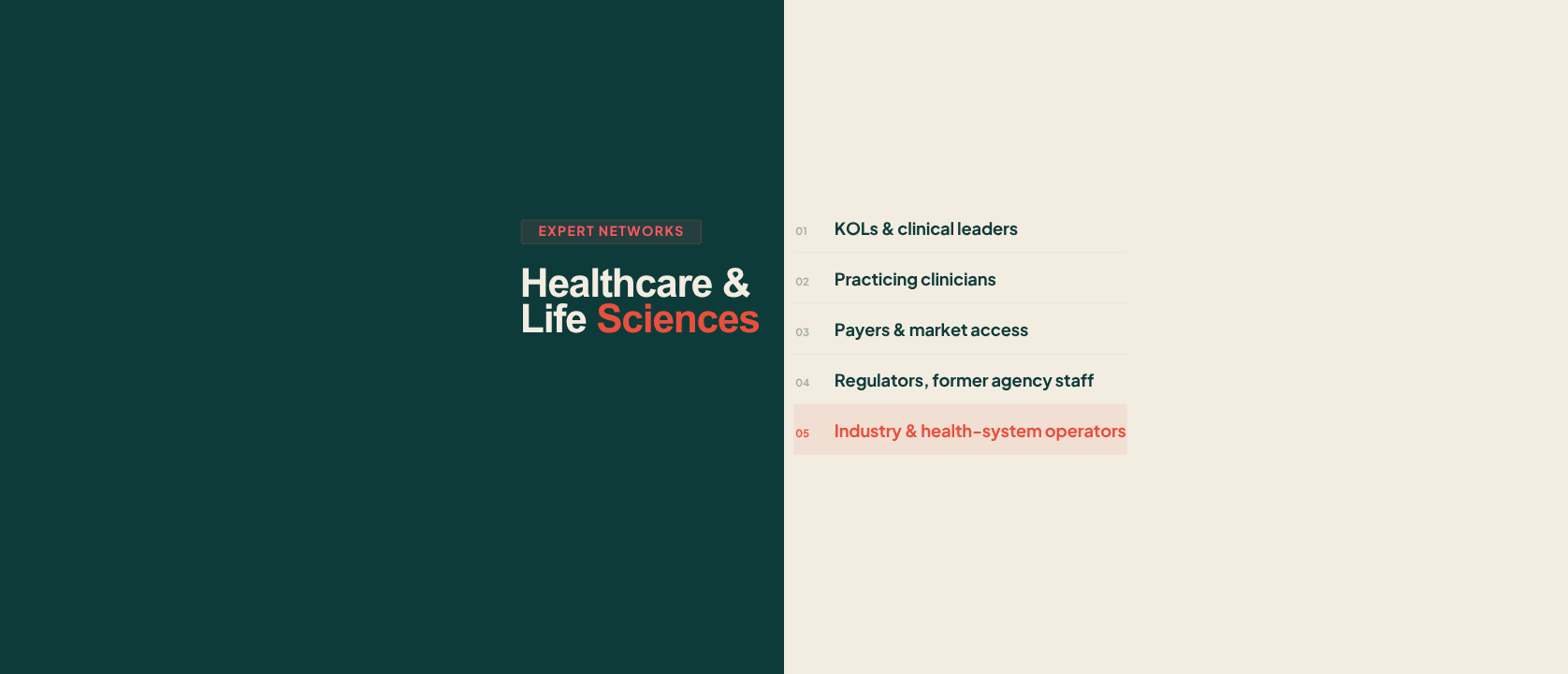
Healthcare and life sciences experts are found through specialist networks (Techspert, M3 Global Research), the healthcare practices of large expert networks (GLG, Guidepoint, Third Bridge), and custom-sourcing providers that recruit clinicians, payers, and health-system operators per brief; Infoquest’s model, strongest for MENA and Asia health systems. The right channel depends on which expert type you need, because KOLs, payers, and hospital operators live in different places and carry different engagement rules.
Healthcare is the category’s most compliance-sensitive vertical; descriptions of providers and engagement rules here are factual and pattern-level; confirm specifics with your counsel and each provider.
The Five Types of Healthcare Experts (and Where Each Lives)
KOLs and clinical thought leaders. Academic and clinical opinion leaders who shape treatment paradigms, publication records, trial leadership, guideline committees. Reached through specialist healthcare networks and the large networks’ healthcare practices; engagement is the most compliance-laden of any expert type.
Practicing clinicians and providers. Physicians, specialists, nurses, pharmacists, the ground truth on treatment behavior, adoption, and workflow. Panel specialists (M3) hold them at survey scale; networks recruit them for calls; response economics and engagement rules vary by country.
Payers and market access. Insurance medical directors, PBM veterans, health-authority reimbursement advisors, HTA-adjacent experts, the people who decide what gets paid for. Scarcer than clinicians, heavily conflict-checked, and disproportionately valuable for launch and pricing work.
Regulators and former regulators. Ex-agency reviewers and policy staff for approval-pathway and compliance questions. Cooling-off rules and topic restrictions are strictest here; credible networks screen these engagements hardest.
Industry and health-system operators. Pharma commercial leaders, biotech R&D, medtech executives, hospital administrators, procurement directors, digital-health founders. The most heterogeneous type, and the one where custom sourcing matters most, because a specific hospital system’s procurement lead or a Gulf health-authority operator is a recruitment problem, not a database lookup.
Best Platforms for Life Sciences and Healthcare Experts, Compared
Techspert
AI-driven specialist sourcing built for healthcare and life sciences, recruiting beyond standing panels into precise clinical and scientific niches. Best for: narrow scientific and clinical profiles at speed.
M3 Global Research
The physician-panel specialist: clinicians and healthcare professionals at survey scale across major markets, with the compliance framework clinical fieldwork requires. Best for: quantitative physician and HCP studies.
GLG
The largest general network’s healthcare practice, breadth across pharma, biotech, medtech, payers, and providers with institutional compliance. Best for: enterprise programs spanning many healthcare sub-sectors.
Guidepoint
Broad healthcare coverage plus Qsight, its healthcare data business, a calls-plus-data combination for medtech and procedure-volume questions. Best for: teams pairing expert calls with healthcare datasets.
Third Bridge
Strong healthcare sector depth for investors, with Forum transcripts covering widely-held names in pharma, services, and medtech. Best for: healthcare investors wanting reading coverage plus calls.
Infoquest
Custom sourcing applied to healthcare: clinicians, payers, and health-system operators recruited per brief, first shortlists in under 2 hours, with standout depth in MENA and Asia health systems, including Arabic-speaking clinical and health-authority profiles that panels don’t hold. Flexible packages with no commitments, at roughly 30% less cost than legacy competitors. Best for: regional health-system work, emerging-market access questions, and hard-to-source operator profiles. Honest limit: for US-physician survey scale, a panel specialist like M3 is the right base layer.
Dialectica
Recruiting-led delivery with growing healthcare depth, at challenger speed and economics. Best for: deal-timeline healthcare diligence in mainstream sub-sectors.
NewtonX
Verification-led surveys reaching hard-to-verify healthcare business titles, market access, digital health, payer-adjacent roles, where sample provenance is challenged. Best for: healthcare B2B quant beyond the clinician panel.
Also relevant: Sermo and similar physician communities for pulse surveys, and Atheneum within its generalist coverage. The full cross-vertical landscape is in our comparison of the best expert networks.
Healthcare Compliance: What Changes in This Vertical
Healthcare engagement layers additional rules on top of standard expert-network controls, and credible providers handle all of them as process, not exception. Clinician engagement rules: fair-market-value compensation standards for practicing physicians, and in some jurisdictions transparency-reporting obligations attached to payments to prescribers. Confidentiality boundaries: no patient-identifiable information, ever, and strict handling of clinical-trial and unpublished-data topics. Adverse-event awareness: pharma-sponsored work can carry obligations to report safety information surfaced in conversations, a workflow the provider should be able to describe. Regulator restrictions: cooling-off periods and topic limits for former agency staff, screened hardest of any profile. Conflict screening: practicing clinicians advising on products they prescribe, or payers on categories they adjudicate, need explicit conflict checks. The category-standard baseline, MNPI, vetting, attestations, audit trails, is in our expert network compliance guide; treat this vertical’s additions as mandatory extensions, and verify each in writing.
Regional Depth: MENA and Asia Health Systems
Health-system research outside the US and Western Europe is where panel coverage collapses fastest, and where demand is growing quickest: Gulf health-system transformation programs, Saudi and UAE payer reform, Asian hospital-group expansion, and market-access questions across both regions. The expertise that matters is institutional and local: health-authority operators, hospital-group executives, regional distributors, and clinicians inside national systems, profiles recruited in-language and in-market, not filtered from a global database. This is the deepest part of Infoquest’s healthcare bench, custom-sourced regional health-system experts across MENA and Asia, in Arabic and English, and the sourcing dynamics behind it are covered in our MENA & GCC guide.
FAQ
For clinical and scientific niches: Techspert. For physician surveys at scale: M3 Global Research. For enterprise breadth: GLG, Guidepoint, Third Bridge. For custom-sourced regional and hard-to-find healthcare profiles, especially MENA and Asia health systems, Infoquest, with shortlists in under 2 hours. Match the platform to the expert type, not the category label.
Custom-sourcing providers with genuine regional recruitment lead here, because health-system expertise is institutional and local: health-authority operators, hospital-group executives, national-system clinicians. Infoquest specializes in exactly this bench across MENA and Asia; global networks add multinational pharma and medtech perspectives on the same markets.
Layer the sourcing: a large network or panel for developed-market clinician and industry coverage, plus a custom-sourcing specialist for the regional health systems where panels thin out. Define expert types per market before briefing; payer access in one country and KOL access in another are different sourcing problems.
On top of identity and employment verification, healthcare vetting adds credential and license checks for clinicians, conflict screening against prescribing or adjudication roles, fair-market-value compensation review, and stricter handling of former regulators. Ask any provider to walk you through their healthcare-specific additions in writing.
Generally yes, within rules: fair-market-value compensation, no patient-identifiable information, conflict screening, and, depending on jurisdiction and sponsor, transparency reporting of payments. Compliant networks manage these constraints as standard workflow; hesitation to explain them is a red flag.