Expert surveys apply quantitative methods to respondents who can’t be reached through consumer panels: executives, clinicians, engineers, procurement leads, and niche operators. Running one well means solving three problems in order: sourcing genuine decision-makers, screening out impostors and professional respondents, and designing instruments experts will actually complete. Provider choice follows from which of the three is hardest for your study.
Surveys vs Calls vs Mixed Methods: When Each Wins
Calls win on depth: mechanism, nuance, the follow-up question that changes the finding. Surveys win on distribution: how common a view is, at what magnitude, across a defensible sample, the difference between “a distributor told us” and “62% of surveyed distributors report.” Mixed methods win most real studies: qualitative calls first to learn what to ask, then quant to size it, or a survey to find signal, then calls to the most interesting respondents to explain it. The practical rule: if the deliverable contains a percentage, you need a survey; if it contains a why, you need calls; consulting and diligence deliverables usually contain both. Vertical-specific patterns are covered on our consulting firms and private equity pages.
How to Run an Expert Survey: The Six-Step Process
- Define the respondent, not the audience. “Supply chain leaders” is an audience; “director-level or above, current budget authority over freight procurement, companies >$100M revenue, GCC-based” is a respondent definition. Every downstream decision- sourcing, screening, pricing- depends on this precision.
- Choose the sourcing model. Standing panels for reachable populations; verification-led open recruiting or custom sourcing for rare ones (see the sourcing section below). Decide before you brief providers, because it determines who can genuinely field the study.
- Build screening that impostors can’t pass. Knowledge-based screeners (questions only a real practitioner answers correctly) beat self-declared titles. Add consistency traps, open-text verification, and, for high-stakes studies, identity verification against professional records.
- Design for expert attention. Experts abandon consumer-style surveys. Keep instruments tight (10–15 minutes), questions concrete and operational, and compensation honest for the seniority you’re asking of. Pilot with three to five respondents from the target population before fielding.
- Field with quality monitoring live. Watch completion patterns, straight-lining, speeders, and open-text quality during fielding, not after; replacing bad completes mid-field is cheap; discovering them in analysis is not.
- Close the loop with calls. Flag the most informative respondents for follow-up interviews. The survey finds the signal; the conversation explains it, and this step is where mixed-methods studies earn their cost.
Sourcing Hard-to-Reach B2B Respondents
The sourcing model determines whether your sample is real:
Standing panels are fast and cheap for populations that opt into panels, mainstream IT decision-makers, SMB owners, but thin out fast at seniority, in niches, and outside developed markets, and they carry the professional-respondent problem: people who survey for a living.
Verification-led open recruiting (the NewtonX model) recruits per study from the open professional graph and verifies identity, built for samples that must survive methodological challenge.
Custom sourcing (the Infoquest model) recruits named-profile respondents against the study brief exactly as it recruits call experts, custom-sourced expert lists, first shortlists in under 2 hours, which is what reaches populations no panel holds: Arabic-speaking Gulf executives, frontier-market operators, ten-person niches. It also produces respondents who are call-able afterward, which makes step six natural.
The honest rule: the rarer and more senior the respondent, the more sourcing beats paneling, and the more each screen matters, because at n=40 senior executives, five impostors is a corrupted study.
Survey Design and Screening for Expert Populations
Beyond the process steps, four design principles separate expert studies that hold up from those that don’t. Screen on knowledge, not titles; titles are claimed, knowledge is demonstrated. Ask about behavior, not opinion; wherever possible, what did your organization buy?” outperforms “what do you think of” for decision-grade findings. Size honestly; expert populations support n=30–100 studies with appropriate framing, not consumer-style significance claims; state it plainly in the deliverable. Document provenance: who was sourced how, screened on what, verified against what. Provenance is what lets a finding survive an investment committee or a client’s methodology review, and it’s the first thing challenged when a finding is inconvenient.
Top Expert Survey Providers Compared
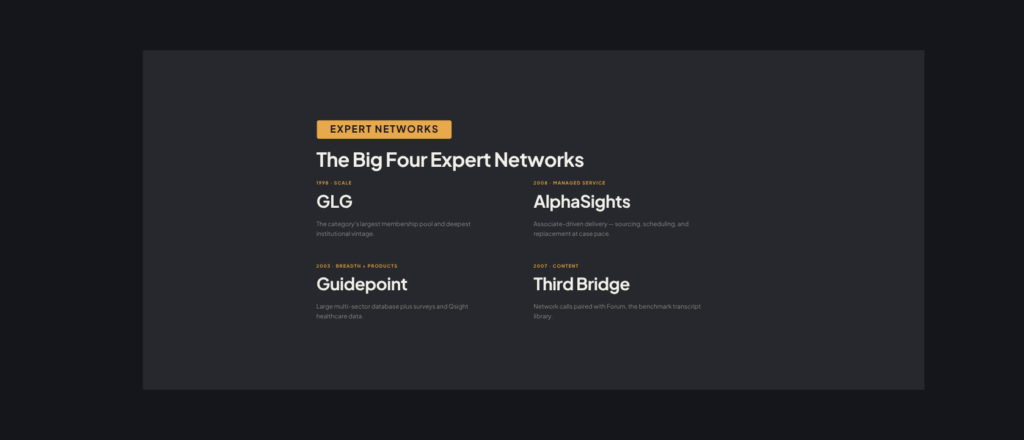
NewtonX
The verification specialist: open-graph recruiting with identity verification per respondent, purpose-built for studies where sample provenance is the whole game. Best for: high-stakes quant that will face methodological scrutiny.
Guidepoint
Survey capability at big-database scale, drawing samples from its multi-sector membership, alongside its calls and data products. Best for: mainstream B2B samples inside an existing Guidepoint relationship.
GLG
Surveys fielded against the category’s largest membership pool, with institutional compliance wrapped around them. Best for: broad senior-professional samples at enterprise scale.
Dialectica
Recruiting-led survey delivery with the turnaround speed of its calls business, growing fast in consulting and PE use. Best for: deal-timeline quant paired with call programs.
Infoquest
Custom-sourced samples recruited per study, the sourcing-model answer for niche, regional, and GCC/MENA populations panels don’t hold, with the same under-2-hour shortlist standard and flexible packages with no commitments, at roughly 30% less cost than legacy competitors. Best for: hard-to-source and emerging-market samples, and mixed-methods studies where respondents become interviewees.
Atheneum
Survey capability within its global generalist offering, on flexible mid-tier terms. Best for: European-anchored studies bundled with call programs.
M3 Global Research
The healthcare panel specialist: clinicians and payers at scale with the compliance framework clinical research requires. Best for: physician and healthcare-professional samples.
The full provider landscape beyond survey capability is in our comparison of the best expert networks.
What Expert Surveys Cost
No provider publishes reliable survey rate cards; pricing moves with respondent rarity, seniority, incidence, sample size, and instrument length, so budget by structure and driver instead. The drivers: rare and senior respondents cost more to source and compensate; low incidence multiplies screening cost; longer instruments raise both compensation and abandonment. The structures: per-complete pricing (pay for qualified completes, cleanest for one-off studies), project-based (a capped fee for the whole study, best for mixed-methods bundles), and program pricing for recurring trackers. Challenger economics apply here as elsewhere; Infoquest’s commitment-free packages price study work at roughly 30% below legacy rates, and the biggest budget lever is usually incidence: a sharper respondent definition costs more per complete and less per usable finding. Structures and negotiation levers in our pricing models guide.
FAQ
For verification-led B2B samples: NewtonX. For samples from large standing memberships: Guidepoint, GLG. For deal-timeline speed: Dialectica. For niche, regional, and GCC/MENA populations recruited per study: Infoquest, with custom-sourced respondent lists in under 2 hours. For clinicians: M3 Global Research. Match the platform to your hardest problem: sourcing, verification, or speed.
Expert studies run on expert-population math: n=30–50 supports directional findings among genuinely rare populations, n=75–150 supports segment cuts among reachable professional groups. What matters more than n is provenance; a verified, well-screened n=40 beats an unverifiable n=400 in any serious review.
Screen on demonstrated knowledge rather than claimed titles, add consistency traps and open-text checks, verify identity for high-stakes studies, and prefer sourcing models that recruit named profiles per study over anonymous panel opt-ins. Monitor quality during fielding and replace bad completes immediately.
Different jobs: surveys produce distribution and magnitude (“how many, how much”), calls produce mechanism (“why, how”). Most decision-grade studies need both, sequenced, which is why mixed-methods capability is worth weighting in provider selection.
Yes, but panel coverage is thinnest exactly there; custom sourcing is usually the only model that fields genuine local samples, including Arabic-speaking executives recruited in their own language. Regional sourcing dynamics are covered in our MENA & GCC guide.