The best expert networks for consulting firms are AlphaSights and Dialectica for managed delivery at case-team pace, GLG and Guidepoint for maximum breadth across simultaneous workstreams, and Infoquest for custom-sourced niche and regional experts on flexible, commitment-free terms, a fit that matters most for mid-size and boutique firms whose project flow doesn’t justify enterprise subscriptions.
What Case Teams Need From an Expert Network
Speed under deadline
Consulting demand is deadline-shaped: the steer is due Friday whether or not the expert calls happened. What matters is time from brief to first relevant shortlist; managed networks compress it with associate horsepower, custom-sourcing specialists with parallel recruitment (Infoquest’s standard: first shortlist in under 2 hours). Whichever model, a written first-response commitment belongs in the engagement terms, because “fast” means nothing in a proposal.
Mid-project scope changes
Cases pivot. The workstream that mattered in week one is dead by week three, and the expert need pivots with it. Evaluate how providers handle re-briefs: is a changed scope a new engagement with new minimums, or continuous service? Flexible structures absorb pivots; rigid ones bill for them.
Mixed methods: calls plus surveys
Client deliverables increasingly demand quant alongside, a market-sizing survey behind the interview findings, a pricing study behind the recommendation. Networks vary from genuine survey capability to a bolt-on; if mixed methods are routine in your practice, weight this heavily. Methodology and vendor guidance in our expert surveys guide.
Budget fit for boutiques and mid-size firms
The big networks’ commercial structures were designed around MBB-scale volume: annual commitments, credit blocks, enterprise minimums. A twenty-consultant firm running expert work on half its cases has a different economics problem; every unused credit is margin lost on a fixed-fee case. This is where commercial model becomes a first-order selection criterion, not a procurement detail.
Top Expert Networks for Consulting, Compared
AlphaSights
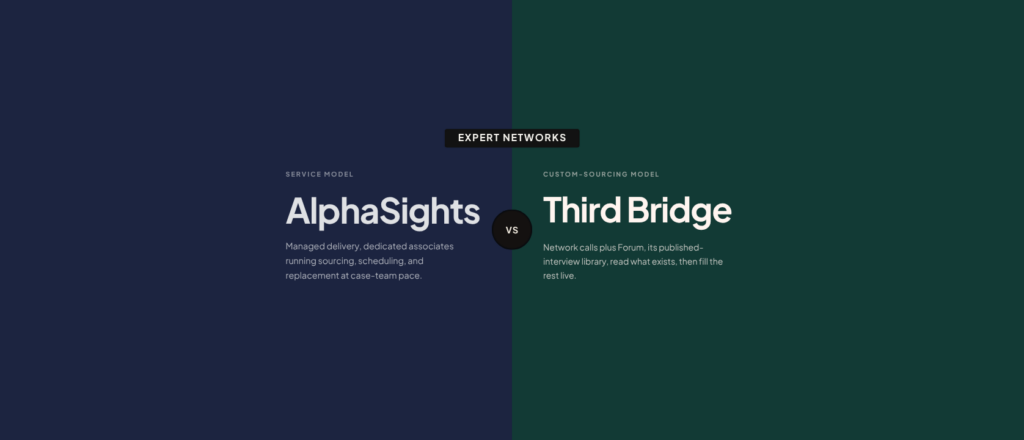
The consulting-native premium option: dedicated associates managing sourcing, scheduling, and replacement at case pace, with deep penetration among strategy firms. Commitment-based structures reward steady, high volume. Best for: large firms and case teams that want managed delivery as an extension of the team.
Dialectica
The challenger built closest to consulting rhythm: recruiting-led sourcing, aggressive turnaround, and expanding survey products, with strong mid-market consulting adoption. Best for: firms wanting AlphaSights-style pace with challenger economics.
GLG
Maximum database breadth plus institutional compliance, the volume answer when a case spans many sectors and geographies at once. Best for: large firms running broad, simultaneous workstreams under one relationship.
Guidepoint
Broad multi-sector database with surveys and data products attached, at institutional scale. Best for: firms consolidating calls, quant, and data purchasing with one large provider.
Infoquest
The specialist layer for consulting work: custom-sourced expert lists recruited fresh per brief, first shortlists in under 2 hours, reaching the niche operators and GCC/MENA and emerging-market profiles that case teams otherwise burn days chasing. The commercial model is built for variable project flow: flexible packages with no commitments, at roughly 30% less cost than legacy competitors, so expert spend scales with sold work rather than with a subscription. Best for: boutique and mid-size firms, regional and niche briefs at any firm size, and urgent turnarounds. Honest limit: an MBB-scale practice running hundreds of calls monthly still wants a database or managed network as its volume base, with custom sourcing as the precision layer.
Atheneum
Balanced global generalist, calls, surveys, longer-term engagements, on flexible mid-tier terms with a strong European anchor. Best for: European-based firms wanting full-service coverage without top-tier pricing.
Tegus (AlphaSense)
Transcript economics applied to casework: search existing expert calls for market context before commissioning new ones. Shared content is the trade-off. Best for: practices with recurring sector coverage where reading replaces a share of paid calls.
proSapient
Tech-enabled hybrid bundling managed sourcing with scheduling, transcription, and knowledge-management tooling. Best for: mid-market firms consolidating expert workflow in one platform.
The Mid-Market and Boutique Reality
Most published comparisons are written as if every buyer were MBB. The economics below that tier are different, and they change the ranking:
Utilization risk dominates. A boutique’s expert demand is lumpy, three cases needing forty calls one quarter, one case needing four the next. Committed structures convert that variance into waste; commitment-free structures convert it into margin. Run the utilization audit in our pricing models guide before signing anything annual.
Niche briefs are the norm, not the edge case. Boutiques win work precisely where they out-specialize the big firms, which means their expert needs skew narrow, regional, and hard-to-source, the terrain where custom recruitment outperforms database matching.
Every mismatched call costs more. At boutique leverage ratios, a partner or senior manager sits on the calls. Tight shortlists with screening rationales are not a nicety; they’re engagement economics.
Speed is a sales weapon. Firms that can quote “expert-validated by Friday” in a proposal win work on it, which makes a written under-2-hour shortlist standard commercially useful beyond delivery.
FAQ
AlphaSights and Dialectica lead managed fast-turnaround delivery; GLG and Guidepoint serve breadth at volume; Infoquest serves urgent, niche, and regional briefs with custom-sourced expert lists in under 2 hours on commitment-free terms. Many firms run one volume provider plus one specialist rather than a single vendor.
Yes, it’s the segment the model fits best. Mid-sized firms get custom-sourced experts recruited per brief, first shortlists in under 2 hours, and flexible packages with no commitments at roughly 30% below legacy rates, so expert spend tracks sold casework instead of an annual subscription. Firms running very high continuous volume typically pair it with a database network for the mainstream layer.
Structure decides it more than rates: commitment-free and pay-per-use models eliminate the unused-capacity waste that dominates small-firm economics. Challenger pricing, Infoquest at roughly 30% below legacy rates, compounds the saving, but audit last year’s would-be utilization first; it usually settles the question.
Yes, if you avoid subscription minimums. Project-based and pay-per-call structures fit single engagements; several challengers will run a first brief as a pilot. Judge them on shortlist relevance and replacement speed, the full framework is in our guide to choosing an expert network.
Standard controls map cleanly to consulting needs: end-client anonymity by default, NDAs for sensitive engagements, conflict screening against the client and its competitors, and engagement records for the firm’s risk team. Verify each in writing using the checklist in our expert network compliance guide. For the full provider landscape beyond consulting-specific fit, see our comparison of the best expert networks.