
Bryan Hoare has spent four decades moving between countries, coaching athletes, advising hotel groups, and studying what actually keeps people healthy. He holds a master’s degree in exercise and nutrition, has worked with private clubs in Hong Kong and Singapore, and recently helped Oberoi Hotels and Resorts design ASMI, a wellness model built around five pillars: movement, nutrition, bodywork, breathwork, and mindfulness. When Infoquest spoke with him, the conversation turned quickly to heart rate variability wearables and the numbers people track obsessively on their wrists.
His view is both enthusiastic and cautionary, shaped by years of watching technology transform wellness and by one very personal experience. A few years ago, Hoare was wearing a Fourth Frontier cardiac wearable when he suffered a severe cardiac event. The device caught it. The data it recorded gave his doctors critical information at a moment when every detail mattered. That experience made him a genuine believer in health tracking. But it also sharpened his thinking about where the limits are.
Why Heart Rate Variability Wearables Are the Most Important Health Metric
The single most important metric Hoare tracks is heart rate variability, or HRV. It measures the variation in time between successive heartbeats and reflects how well the nervous system is functioning. A higher HRV means the heart is flexible and responsive. A lower one signals stress, fatigue, or illness. HRV is, in his words, the most important measure of overall health because it tells you about the body’s ability to react to any given situation.
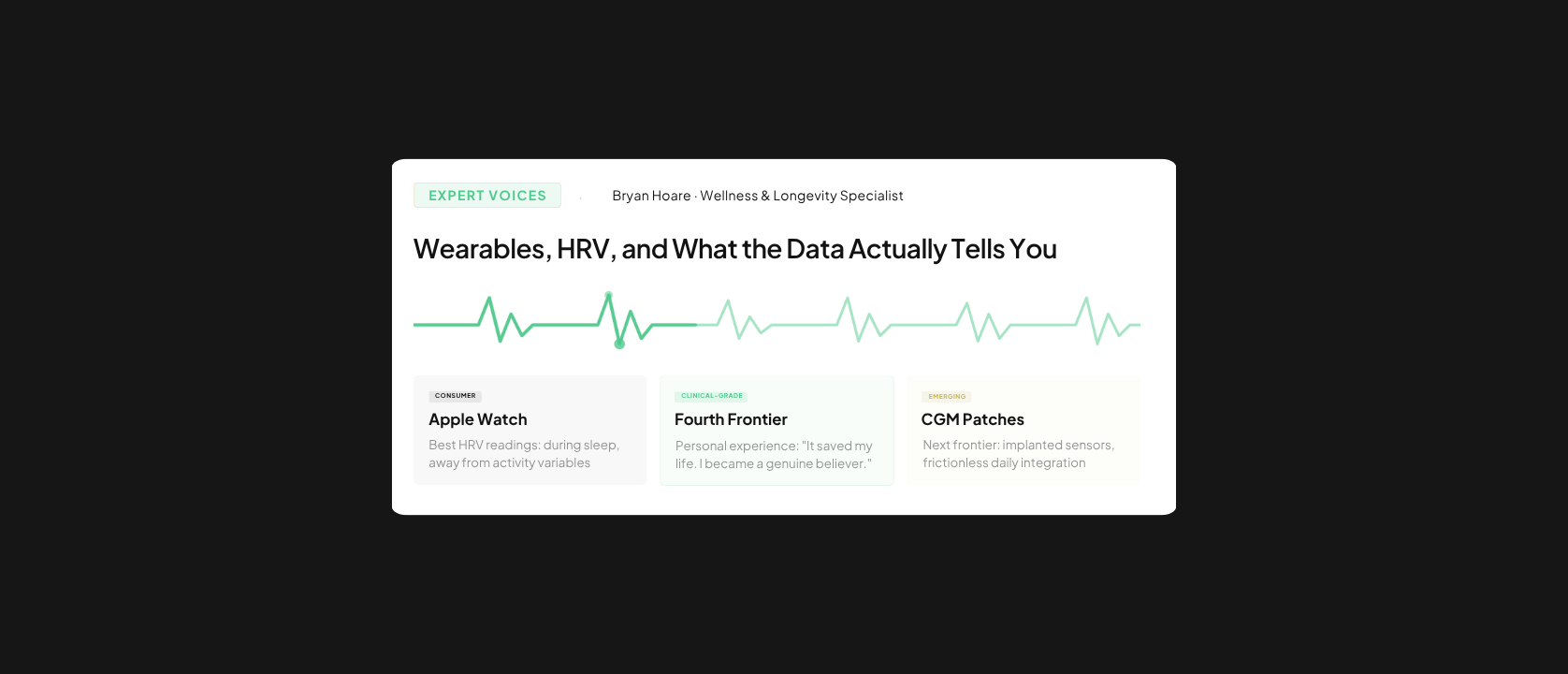
The Apple Watch tracks HRV, and Hoare considers it a genuinely useful tool for the general population. But there is a significant caveat: the data it produces is algorithm-based rather than clinical. It offers solid directional trends, but it is not medical-grade. For the most accurate HRV readings specifically, he recommends checking the metric during sleep, when activity and external variables are not distorting the numbers.
Apple Watch vs. Medical-Grade Devices: Understanding the Accuracy Gap
The distinction between consumer devices and clinical-grade monitors matters more than most people appreciate. Medical-grade tools like Holter monitors are far more precise, but they are disruptive by design. They exist for diagnostics, not daily life. Consumer wearables occupy the gap between those two categories, and that gap is narrowing but has not closed.
Hoare frames this clearly: the Fourth Frontier device that caught his cardiac event sits closer to the clinical end of that spectrum than a standard smartwatch does. It is built for serious cardiac monitoring. The Apple Watch, by contrast, is built for broad accessibility and lifestyle awareness. Neither is wrong for what it does. The risk comes when people treat consumer-grade data as clinical-grade certainty.
| Device | Category | Accuracy Level | HRV Tracking | Best Used For |
|---|---|---|---|---|
| Apple Watch Consumer Smartwatch | Consumer |
Algorithm-based — directional trends
|
Sleep only ✓ | Daily awareness, lifestyle baselines, general trend monitoring |
| Fourth Frontier Cardiac Wearable | Hybrid |
Clinical-adjacent — ECG-grade data
|
Yes ✓ | Cardiac event detection, athletic performance, high-risk individuals |
| Holter Monitor Clinical EKG Device | Medical-Grade |
Highest accuracy — diagnostic standard
|
Yes ✓ | Clinical diagnosis, prescribed monitoring — disruptive to daily life |
| CGM Patch Continuous Glucose Monitor | Hybrid |
High accuracy — real-time biochemical data
|
Not applicable | Metabolic tracking, nutrition optimization, diabetes management, elite sport |
Glucose Monitoring Patches and the Next Wave of Integrated Health Tracking
Hoare sees continuous glucose monitoring patches as an early indicator of where health tracking is heading. Originally developed for people with diabetes, these monitors have been adopted widely by athletes and performance-focused individuals who want to see in real time how food and exercise affect blood sugar. He expects the same trajectory to play out across other health metrics: clinical origins, adoption in elite sport, eventual mainstream use.
Longer term, he anticipates health tracking becoming more integrated into daily life, potentially including implanted devices. The friction between wearing something and capturing accurate data will diminish significantly over the coming decade. What is niche today in the GCC and global wellness markets will be standard consumer technology within a generation.
The Hidden Risk of Over-Tracking: When Data Becomes Anxiety
Hoare is willing to name the risk that often gets skipped in conversations about health technology. Over-tracking can generate anxiety. The same data that guides better decisions can become a source of chronic stress when people check it constantly. He draws a direct parallel to the way organizations misuse KPIs: the number was designed to inform behavior, not to produce pressure for its own sake.
His advice is straightforward: use data to make better choices, not as a running score of how well you are performing as a person. Daily check-ins reveal meaningful trends. Minute-to-minute monitoring rarely does. The goal is awareness and action, not surveillance.
Technology Should Simplify Health, Not Complicate It
This connects to something Hoare returns to repeatedly in his work: the core principles of health have not changed. The wellness industry, he argues, tends to overcomplicate what is actually simple. Eat well, sleep enough, move regularly. Those fundamentals are universal across cultures, whether in the GCC, Southeast Asia, or Europe, and have been understood for decades. Technology that supports them should make it easier to follow through, not harder.
He makes the point plainly: human needs are not defined by technology. They can be supported by it, or they can be undermined by it. The goal is to deploy the right tool for the right person at the right time. For most people, that means using a wearable to build awareness and spot trends rather than treating every metric as a diagnosis.
For companies entering the health and wellness space globally, Hoare sees the same logic applying at a business level. The brands that will endure are the ones built on authenticity and evidence, not novelty or complexity. A wellness model that genuinely works tends to be simpler than it looks. It needs to bring real value to the customer and be replicable across different environments. Brand equity built on valid truths compounds. Brand equity built on overclaiming does not survive scrutiny.
The technology will keep evolving. More metrics, better sensors, tighter integration with clinical data systems. What Hoare argues will not change is the underlying human biology those tools are measuring, and the basic discipline required to act on what they show.