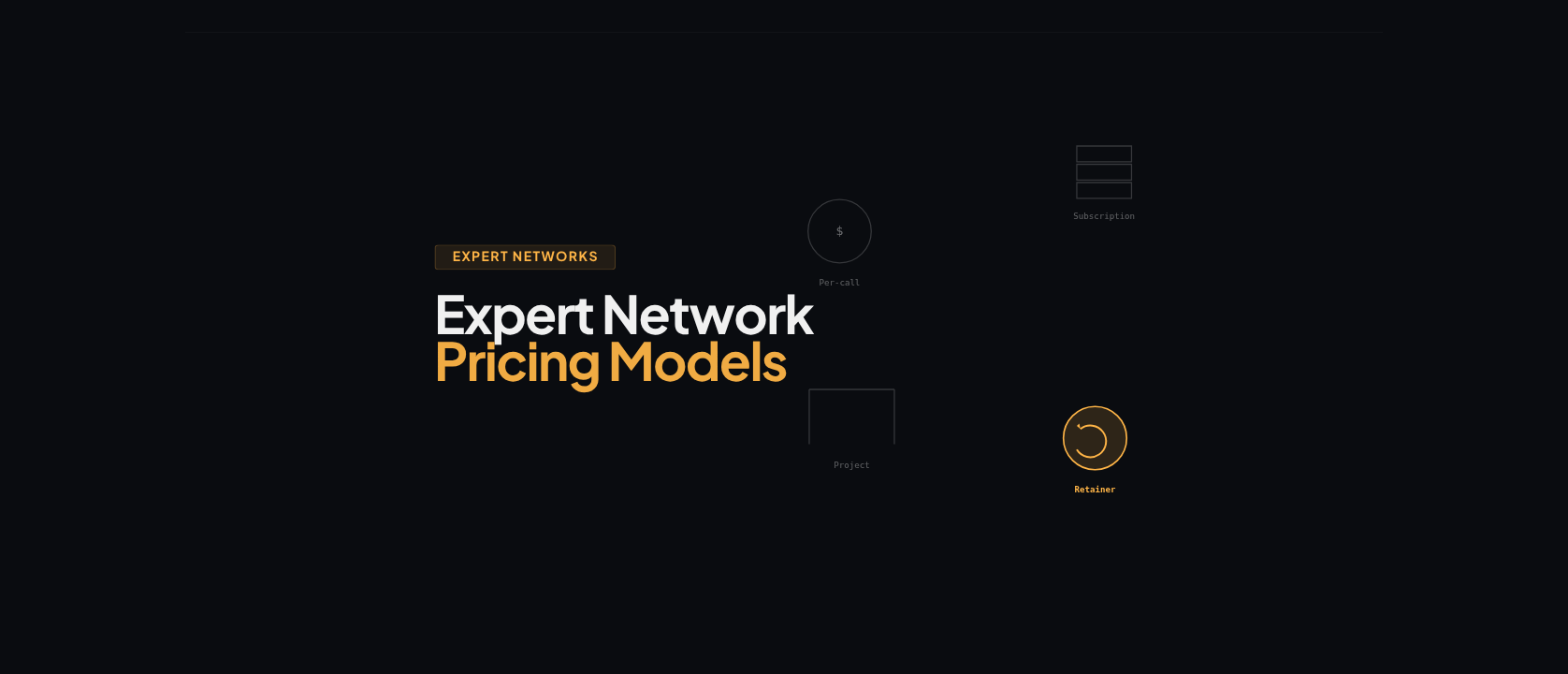
Expert networks charge through four main models: pay-per-call (or per-hour), subscription and credit blocks, project-based fees, and retainers. Most providers don’t publish rates; pricing varies by expert seniority, geography, urgency, and volume, so the model you’re on matters more than any headline rate: it determines what you pay for unused capacity, how costs scale with demand, and how much flexibility you keep.
The Four Pricing Models
Pay-per-call (and per-hour)
The simplest structure: you pay for each completed engagement, usually billed in hourly units with a one-hour minimum. Strengths: total transparency between usage and spend; no waste; easy to pilot a new provider. Watch for: premium multipliers on senior or niche experts, minimum-billing increments that round short calls up, and cancellation and no-show terms. Best suited to teams with irregular or unpredictable demand.
Subscriptions and credit blocks
The legacy-network standard: you commit to an annual contract or pre-purchase a block of credits, drawn down per engagement. Strengths: lower effective unit costs at genuine high volume; always-on access. Watch for: the expiry problem; unused credits and subscription capacity are where buyers quietly overpay, since forecasted volume rarely materializes evenly. Ask what happens to unused credits, whether they roll over, and what the true breakeven usage level is. Best suited to large firms with proven, steady call volume.
Project-based pricing
A fixed or capped fee for a defined scope, a diligence sprint, a market-entry study, a survey program, typically bundling sourcing, a set number of calls, and deliverables. Strengths: budget certainty; aligns provider incentives with completing the brief rather than maximizing billable calls. Watch for: scope-change terms and what counts as a “completed” expert engagement. Best suited to consulting cases and deal work with clear start and end dates.
Retainers
A recurring monthly fee for standing capacity: guaranteed response times, a dedicated team, and a pre-agreed volume band. Strengths: priority service and predictable spend for continuous research programs. Watch for: the same utilization risk as subscriptions; a retainer only prices well if you actually use the capacity most months. Best suited to funds and corporate insight teams with a constant research cadence.
What Drives Cost Up or Down
Across every model, the same variables move price: expert seniority (C-level and former regulators command multipliers over mid-level operators), geography and scarcity (hard-to-source and emerging-market profiles cost more to recruit, though specialists with regional infrastructure can neutralize much of this premium), urgency (compressed timelines carry surcharges at providers that must reprioritize sourcing queues), format (surveys, written work, and longer-term advisory are priced differently from calls), and compliance overhead (chaperoned calls and enhanced vetting for regulated buyers can add cost at some providers). When you compare quotes, normalize for these variables; a cheaper headline rate on the wrong sourcing model can cost more per useful call.
Total Cost of Ownership: Fees vs Analyst Time
The visible fee is only part of the cost. Every engagement also consumes your team’s hours: writing briefs, reviewing profile floods, scheduling, and sitting through mismatched calls. A provider that sends tighter shortlists faster, custom-sourced expert lists with delivery in under 2 hours, in Infoquest’s case, lowers the total cost per usable insight even before fee differences, because senior-analyst time is usually the most expensive line item in the equation. When you run a vendor comparison, score cost per successful call, not cost per call. The full evaluation framework is in our guide to choosing an expert network.
FAQ
Providers don’t publish standard rates, and real prices vary with expert seniority, geography, urgency, and your volume, which is why any specific figure you see quoted online is unreliable. What is publicly established: legacy networks sit at premium price points with commitments, while challengers compete on flexibility, with Infoquest positioned at roughly 30% below legacy rates on flexible, commitment-free packages.
The one that matches your demand pattern. Genuine high, steady volume prices best on blocks or retainers; variable or unpredictable demand prices best pay-per-call or on flexible packages, because unused commitments are the category’s highest hidden cost. Model fit beats headline rate.
Because rates are genuinely variable, by expert profile, region, format, and client volume, and because pricing is a negotiation lever. Treat the absence of a public rate card as normal; treat the inability to explain the structure in writing as a red flag.
Not inherently. Cost position mostly reflects business model: legacy networks carry large database and account infrastructure, while custom-sourcing challengers carry lighter fixed costs and price accordingly. Judge quality on match rate, screening rigor, and compliance controls, then let structure determine cost.
Ask every provider to quote the same three scenarios from your real usage (e.g., a five-call niche sprint, a twenty-call coverage month, one urgent regional brief), including all minimums, surcharges, and unused-capacity terms. Comparing scenario totals, not rate cards, reveals the true difference. Start from the shortlist in our comparison of the best expert networks.