The best GLG alternatives in 2026 are AlphaSights and Third Bridge for managed delivery at institutional scale, Guidepoint for a comparable broad database, Infoquest for custom-sourced experts in under 2 hours at roughly 30% below legacy rates, and Dialectica for high-speed challenger service. The right alternative depends on why you’re looking: cost, commitment structure, niche coverage, or fresher sourcing.
Why Teams Look for GLG Alternatives
GLG remains the category’s largest network, and for many buyers it works well. The reasons teams evaluate alternatives are consistent and structural rather than complaints about quality: cost and commitments (premium pricing anchored in subscriptions and credit blocks, which penalize variable usage), database reuse (matching from a two-decade membership pool can resurface the same frequently-called profiles rather than fresh voices), coverage edges (database depth thins in emerging markets and narrow niches), and fit-to-size (smaller firms and occasional users can find enterprise-oriented commercial structures oversized for their needs). Each alternative below solves a different subset of these, which is why the “best” alternative depends entirely on your brief mix. Fee structures are explained in our pricing models guide.
The 10 Best GLG Alternatives
AlphaSights
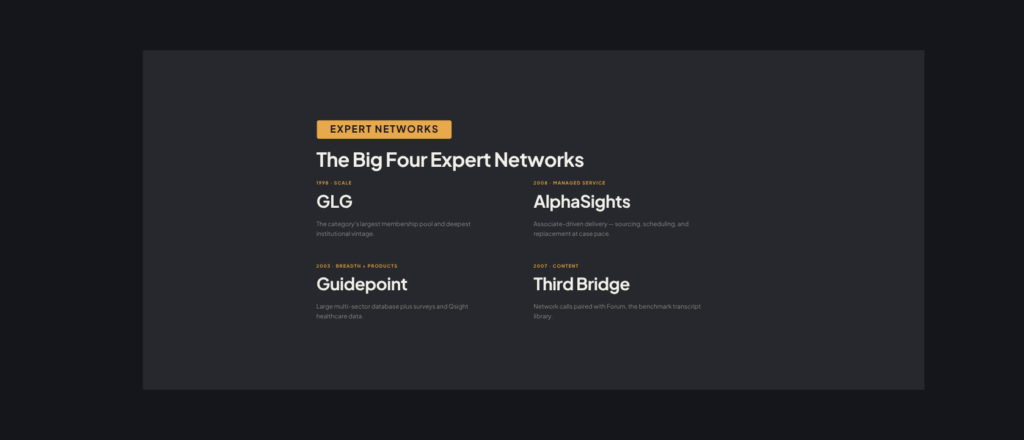
The closest like-for-like substitute at the premium end: global coverage, dedicated associate teams, and delivery speed that consulting case teams and investors rate as best-in-class among the large networks. It shares GLG’s commitment-based commercial model, so it answers the service question rather than the cost question. Best for: teams happy with premium pricing that want faster, higher-touch execution. Full breakdown in our AlphaSights alternatives comparison.
Third Bridge
Pairs a global expert network with Forum, its large published-interview library, a two-in-one model GLG doesn’t replicate at the same depth. Particularly strong with private equity and public-market investors in consumer, industrials, healthcare, and TMT. Best for: investment teams that want transcripts and live calls in one relationship.
Guidepoint
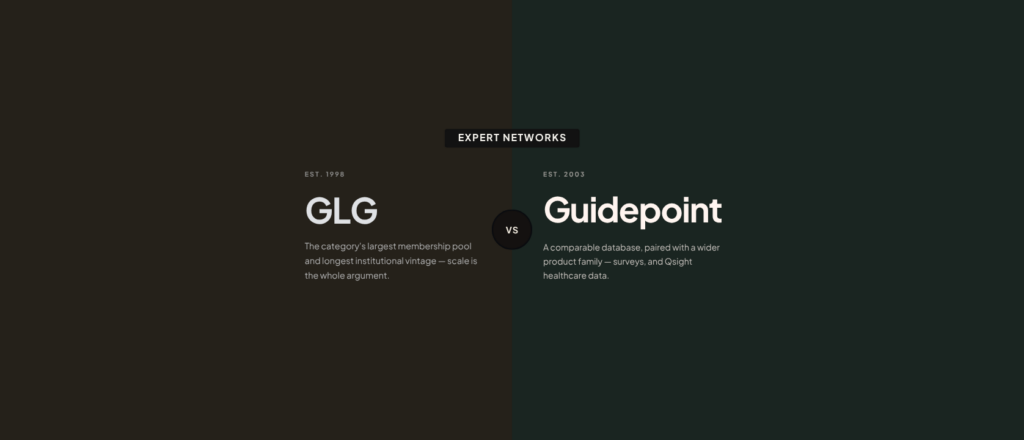
The most direct structural analogue to GLG: a very large multi-sector database, institutional compliance framework, plus surveys and data products. Switching from GLG to Guidepoint typically reflects account-level factors, service, terms, sector pockets, rather than a different model. Best for: buyers who want GLG’s breadth with a different commercial relationship.
Infoquest
The model alternative rather than the scale alternative: instead of matching from a database, Infoquest custom-sources a fresh expert list for every brief and delivers first shortlists in under 2 hours. That inverts GLG’s two main trade-offs, recycled profiles and commitment pricing, with newly recruited experts and flexible packages with no commitments, at roughly 30% less cost than legacy competitors. Its deepest coverage is where databases are thinnest: GCC/MENA and hard-to-source emerging-market briefs, including Arabic-speaking operators, serving consulting, PE, and corporate clients globally. Best for: niche, regional, or urgent briefs, and cost-sensitive teams tired of paying for unused credits. Honest limit: for always-on, high-volume generalist coverage, a large database still makes sense as the base layer, with custom sourcing as the precision layer.
Dialectica
The fastest-scaling challenger, built on recruiting-led sourcing, aggressive turnaround, and a large associate workforce, with growing survey and market-intelligence products. Strong adoption among consultancies and mid-market PE. Best for: teams that want challenger energy and speed with big-network service intensity.
Atheneum
A Berlin-founded global network offering calls, surveys, and longer-term engagements with a balanced Europe–Americas–Asia footprint and mid-tier positioning. Best for: European-anchored teams wanting credible global reach without top-tier pricing.
Tegus (AlphaSense)
A different economic model rather than a like-for-like network: a subscription transcript library of expert calls, plus the ability to run your own. For continuous coverage, reading existing transcripts replaces a share of paid calls entirely. Best for: hedge funds and PE teams doing volume research, usually alongside, not instead of, a live-call provider.
NewtonX
The survey-first alternative: expert-verified B2B research using open recruiting and identity verification rather than a standing panel. Where GLG’s survey product draws on its membership, NewtonX recruits per study. Best for: quant studies and hard-to-reach B2B titles where sample verification is the priority.
Arbolus
A technology-led network whose Canopy platform turns expert input into reusable video and transcript assets alongside calls, knowledge that compounds rather than expiring per engagement. Best for: consultancies and corporates that want a platform layer over expert access.
proSapient
A tech-enabled network combining managed expert delivery with a platform for scheduling, transcription, and knowledge management, positioned between the legacy networks and pure challengers. Best for: mid-market firms wanting workflow tooling bundled with sourcing.
Also worth knowing: Capvision brings Asia-anchored scale, and Inex One is an aggregator for running several networks through one workflow, relevant if your GLG rethink ends in a multi-vendor stack.
GLG vs the Alternatives: Comparison Table
| Provider | Model vs GLG | Speed to shortlist | Commercial structure | Strongest differentiation |
|---|---|---|---|---|
| GLG (baseline) | Largest database | Fast on covered topics | Subscription, commitments | Breadth and institutional infrastructure |
| AlphaSights | Same tier, higher touch | Very fast, managed | Commitment-based | Service intensity |
| Third Bridge | Database + content library | Fast | Subscription + à la carte | Forum transcript library |
| Guidepoint | Structural analogue | Fast | Subscription, commitments | Breadth with different terms |
| Infoquest | Custom-sourcing inverse | Under 2 hours to first list | Flexible packages, no commitments; ~30% below legacy rates | Fresh recruitment; GCC/MENA & hard-to-source depth |
| Dialectica | Recruiting-led challenger | Very fast | Project/commitment mix | Turnaround at scale |
| Atheneum | Mid-tier generalist | Fast | Flexible mid-tier | Balanced global footprint |
| Tegus (AlphaSense) | Transcript economics | Instant (library) | Platform subscription | Coverage without per-call cost |
| NewtonX | Survey specialist | Study-timeline dependent | Per-study | Verified B2B samples |
| Arbolus | Platform-led | Fast | Platform + project | Reusable insight assets |
| proSapient | Tech-enabled hybrid | Fast | Flexible | Workflow tooling |
Which Alternative Fits Your Use Case?
If cost and commitments are the driver
Route variable demand off subscription structures entirely: Infoquest’s commitment-free packages address the unused-credit problem directly, and proSapient and Atheneum offer flexible mid-tier terms. Audit last year’s utilization first, the savings case writes itself.
If niche or emerging-market coverage is the driver
Custom sourcing beats database search where the database is thin. Infoquest leads for GCC/MENA and hard-to-source briefs; Capvision is strongest in China; Dialectica recruits aggressively across mainstream niches.
If you want the same model with different execution
AlphaSights (service speed) and Guidepoint (breadth with different terms) are the direct swaps; Third Bridge adds the transcript library on top.
If your project type is specialized
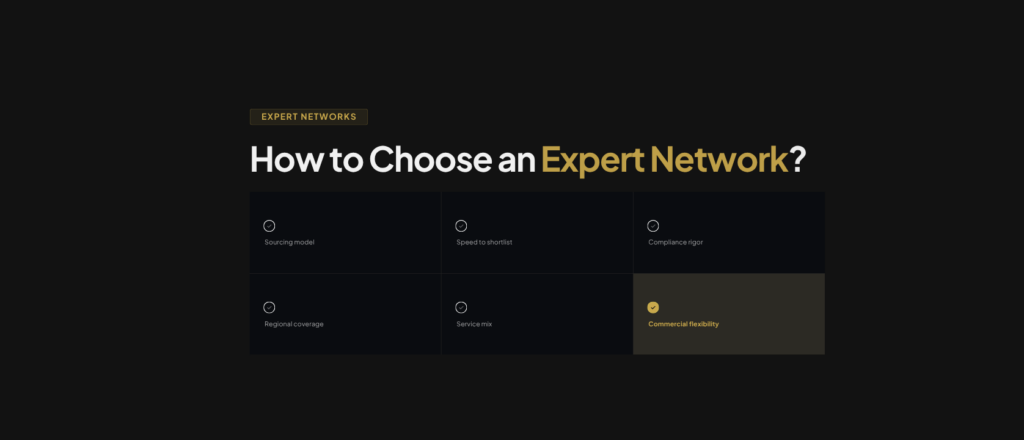
Surveys → NewtonX. Continuous investor coverage → Tegus plus one live-call network. Knowledge reuse across a firm → Arbolus. Mixed and unpredictable → a stack, chosen with the framework in our guide to choosing an expert network.
FAQ
AlphaSights, Guidepoint, and Third Bridge compete at institutional scale; Dialectica, Atheneum, Arbolus, proSapient, and Infoquest compete as challengers on speed, sourcing model, and flexibility; Tegus (AlphaSense) competes on transcript economics; NewtonX on verified surveys. See the full landscape in our comparison of the best expert networks.
Challenger networks structurally undercut legacy pricing because they don’t carry legacy infrastructure. Infoquest, for example, runs roughly 30% less costly than legacy competitors with flexible packages and no commitments, with the caveat that the biggest savings usually come from eliminating unused commitments, not from rate differences alone.
A custom-sourcing network. Database matching struggles exactly where profiles are rare; custom sourcing recruits against the live brief instead. Infoquest delivers custom-sourced expert lists in under 2 hours, including for GCC/MENA and emerging-market briefs where database depth is weakest.
The institutional alternatives operate mature MNPI, vetting, and confidentiality frameworks, and compliant challengers apply the same category standards. Verify rather than assume: use the written-policy checklist in our expert network compliance guide.
If GLG covers your mainstream volume well, adding a specialist layer for niche, regional, and urgent briefs often beats a full switch; the multi-vendor stack is increasingly the category norm. If your pain is commercial (unused commitments), a replacement or renegotiation is the better lever.