Based on an Infoquest Expert Voices interview with Punit Thakker, Founder, Fraction.com
For any founder eyeing the GCC, fintech licensing in the Middle East can feel like a maze of acronyms and unfamiliar terms. Punit Thakker, founder of Fraction.com and a veteran of the region’s payments industry, has spent years helping startups find their way through it. His advice starts with a simple reframe. Licensing is not a hurdle to clear before building a great product. It is part of the product itself.
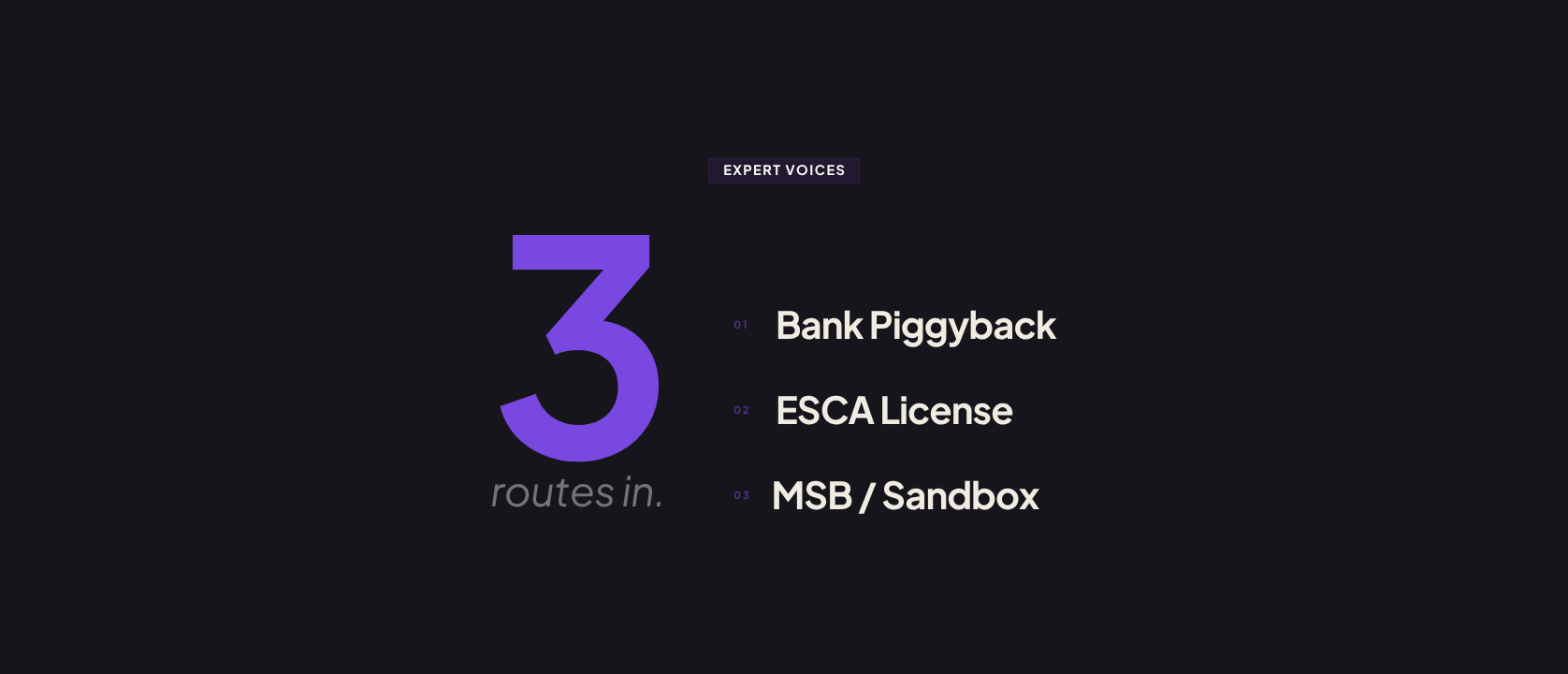
The Three Routes Into Fintech Licensing in the Middle East
Thakker breaks the landscape into three broad paths. The first is piggybacking on an existing bank’s license, running a card or acquiring program under that bank’s regulatory umbrella. The second covers ESCA licenses, used for payment aggregation and acquiring activity across mainland and free zone authorities. The third is the money service business, or MSB, route, which includes stored value facilities for digital wallets and card issuance.
Each path carries its own compliance load. An MSB license, for instance, covers four core activities: issuing prepaid cards, money transmission, holding payment accounts such as virtual IBANs, and storing value. Choosing the right combination from the start saves founders from costly re-licensing down the line.
Three Routes Into Fintech Licensing in the Middle East
A founder’s quick comparison of the main regulatory paths
Bank-Sponsored License
Operate under an existing bank’s license to run card or acquiring programs. Fastest route to market, but compliance is governed entirely by the sponsoring bank’s framework.
Best for: Fintechs partnering closely with an established bank from day one.
Payment Aggregation License
Covers payment aggregation and acquiring activity across mainland and free zone authorities. Suited to platforms processing merchant transactions at scale.
Best for: Payment gateways and merchant acquiring businesses.
Money Service Business
Covers card issuance, money transmission, payment accounts (virtual IBANs), and stored value. Requires a segregated client money account at a licensed bank.
Best for: Digital wallets, prepaid cards, and expense management platforms.
Why Segregation of Client Funds Is Non-Negotiable
Whichever license a fintech holds, one principle stays constant: a company cannot touch the client money account. Customer funds sit in a segregated pool account at a licensed bank, while the fintech operates as a digital layer on top. Thakker describes this as the foundation of trust between a startup, its banking partner, and the regulator. Get this wrong, and no amount of clever technology will save the business.
What a Regulatory Sandbox Actually Does
For early-stage fintechs, a full license can be both slow and expensive. Thakker points out that the share capital alone for a full-fledged license can run into the millions of dollars, and approval can take a year. A sandbox, by contrast, is a scaled-down version of that license, granted for a limited period so a startup can test its product with real customers under lighter compliance requirements.
Sandboxes typically come with phased caps. A digital wallet might be allowed 100 customers in phase one, 500 in phase two, and several thousand in phase three, with regulatory capital requirements rising at each stage. Authorities such as the DFSA in Dubai offer an Innovation Testing License built around exactly this model. Meet the conditions, and the path to a full license opens up.
The Sandbox-to-Full-License Pathway
How a fintech moves from regulatory sandbox to full-fledged license
Apply for a Sandbox or ITL License
A startup applies for a mini license, such as the DFSA’s Innovation Testing License, instead of a full license that could cost millions in share capital and take a year to obtain.
Phase One: Test With a Small Customer Base
The regulator sets a customer cap, often around 100 users, with a lighter regulatory capital requirement to match. The fintech tests core product flows in a live environment.
Phase Two: Scale to Hundreds of Customers
As compliance and operations prove stable, the cap expands toward 500 customers, with regulatory capital requirements increasing in step.
Phase Three: Approach Full-Scale Volumes
The fintech moves toward thousands of customers, refining governance, fund segregation, and reporting to meet the requirements of a full license.
Graduate to a Full-Fledged License
Once all sandbox conditions are satisfied, the regulator grants a full license. Tabby followed this path, with its per-transaction cap rising from 500 to 3,000 dirhams as trust was established.
Tabby and the Rise of Sandbox-Born Licenses
Some of the GCC’s best-known fintech success stories grew up inside sandboxes. Tabby, the buy now pay later platform, launched before a dedicated regulatory category even existed. Regulators recognized the model as innovative and brought it under a new short-term financing license. As Tabby proved itself, its per-transaction cap rose from 500 dirhams to 3,000 dirhams, a direct result of demonstrated compliance and trust.
Wallet providers and expense management platforms have followed similar trajectories, starting under an MSB sandbox in one country before piggybacking on licensed partners to expand regionally. Saudi Arabia’s Fintech Saudi ecosystem, which already counts close to 300 fintech companies and is targeting a thousand, shows just how much room there is for this pattern to repeat.
Open Banking Adds a New Layer of Opportunity
Alongside licensing, Thakker sees open banking reshaping what fintechs can build. Account aggregation lets lenders pull verified financial data directly from a national ID rather than relying on uploaded bank statements, sharpening credit scoring and anomaly detection. Payment initiation services enable real-time account-to-account transfers, cutting both cost and settlement time for merchant payouts, payroll, and B2B invoicing.
Banks, he argues, are largely ready. The bigger hurdle is participation as member banks under protocols like ISO 20022, since open banking only works when banks plug into the network. Compared with mature markets in Europe and the UK, the GCC’s open banking ecosystem is still early, but Thakker expects cross-border, real-time payments across the region within a few years.
Thakker’s Advice: Start Small, Comply First, Innovate Within the Framework
Asked what he tells founders chasing a license, Thakker keeps it simple. Be bold with the product vision, but keep the execution simple enough that customers immediately understand it. On the regulatory side, pick one country, choose only the licenses needed today, and get the compliance and governance right before adding new activities or expanding elsewhere.
The bigger lesson running through Thakker’s view of fintech licensing in the Middle East is that compliance and innovation are not opposing forces. Sandboxes, segregation rules, and phased licenses exist precisely so that startups can experiment safely while regulators protect customers. For founders willing to start small, comply first, and build trust step by step, the region’s regulatory frameworks become less of an obstacle and more of a launchpad.