
The best expert networks for Asia depend on the sub-region: Capvision leads China-anchored scale, Lynk brings Asia-based sourcing across the region, the global networks GLG, AlphaSights, Third Bridge, and Guidepoint serve APAC through regional hubs with depth on internationally visible companies, and Infoquest applies custom sourcing to Asia’s hard-to-reach markets and the fast-growing Gulf–Asia investment corridor. In Asia more than anywhere, “regional coverage” claims need to be tested market by market.
Why Asia Sourcing Is Different
Language fragmentation. Mandarin, Japanese, Korean, Bahasa, Hindi, Thai, Vietnamese- senior operating knowledge across APAC lives in a dozen languages, and English-language database coverage decays fast outside multinationals and the region’s financial hubs. A network’s real capability is recruiting in the market’s language, not filtering profiles by “English: fluent.”
Market heterogeneity. Japan’s consensus-driven corporate access, Korea’s chaebol structures, India’s promoter-led groups, Southeast Asia’s family conglomerates- each market has its own access logic. Pan-Asian depth is really a portfolio of country capabilities, which is why coverage claims should be tested per market, not per region.
Regulatory sensitivity. China, in particular, has tightened the environment for expert consultations in recent years, with data-security, state-secrets, and cross-border information rules that have reshaped how networks operate there. Credible providers can explain their China engagement controls in writing: topic restrictions, expert screening, and how cross-border calls are handled. Treat a provider’s fluency on this question as a proxy for their seriousness in the market; the baseline control framework is in our expert network compliance guide.
Expert Networks With Genuine Asia Coverage, Compared
Capvision
The region’s scale player: China-anchored with one of the largest expert pools in Asia and deep mainland corporate coverage, plus international reach. Best for: China-centric research and pan-Asian programs anchored in Greater China.
Lynk
Asia-based network with sourcing across the region’s markets and a technology-led platform. Best for: Asia-first programs wanting regional sourcing DNA rather than a global network’s regional desk.
GLG
The largest global database serving APAC through regional presence, strongest on multinational executives, listed-company profiles, and cross-border perspectives. Best for: enterprise clients extending an existing global relationship into Asia.
AlphaSights
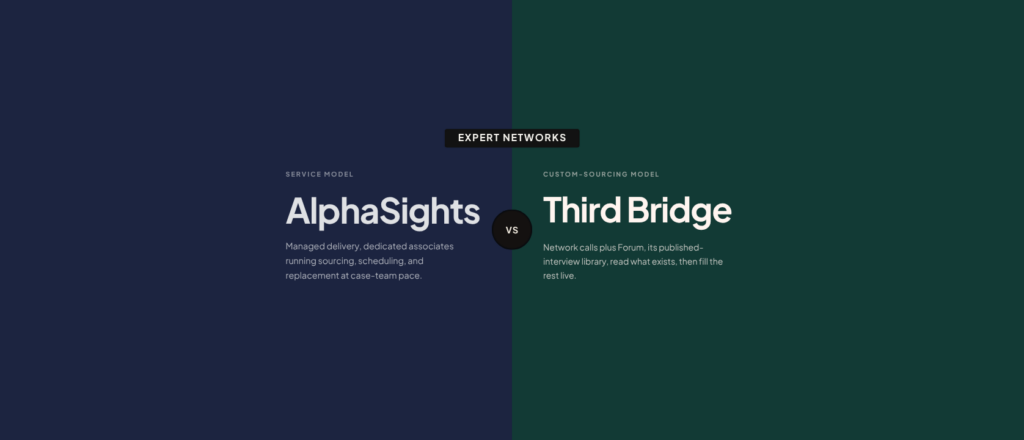
Premium managed delivery through Asian hubs, at the speed its consulting and investor clients expect globally. Best for: case teams and funds running APAC workstreams inside a global engagement.
Third Bridge
Network plus Forum transcripts with investor-focused Asia coverage, strongest on the region’s widely-held names. Best for: investors pairing reading coverage with calls on Asian large-caps.
Guidepoint
Broad global database with Asian reach and survey products. Best for: breadth-led programs that include APAC among many regions.
Infoquest
Custom sourcing applied to Asia’s hardest briefs: local operators in Southeast and South Asian markets where databases are thinnest, recruited per brief in-language, first shortlists in under 2 hours, plus the region’s distinctive cross-border angle: the Gulf–Asia corridor, where sovereign-capital flows, Asian corporates entering MENA, and Gulf groups investing eastward create briefs needing experts on both sides. Flexible packages with no commitments at roughly 30% less cost than legacy competitors. Best for: market-entry and hard-to-source briefs across emerging Asia, and any project spanning the Gulf and Asia. Honest limit: for mainland China depth at scale, Capvision and the global networks’ China desks are the right base.
Dialectica
Recruiting-led challenger extending its turnaround model into APAC coverage. Best for: deal-timeline briefs on the region’s more mainstream profiles.
Also relevant: Atheneum within its global generalist footprint, and specialist boutiques in single markets, often worth adding for Japan and Korea specifically, where local access logic rewards local specialists.
Finding Experts for Market Entry in Asia
Market entry is the region’s signature brief, and it needs a specific expert mix, in sequence: regulatory and licensing veterans to map what’s actually required (not what’s published), incumbent operators who reveal how the market really competes, channel and distribution experts for the go-to-market that determines most entry outcomes, and failed and successful entrants, executives who ran a comparable entry, whose lessons are the cheapest available. Database networks surface the multinational side of this mix; the local incumbents and channel operators are recruitment terrain, market by market. This sequencing logic applies to any geography — the same mix, with Arabic-speaking sourcing, drives Gulf entries via our MENA & GCC guide, and the general evaluation framework is in our guide to choosing an expert network.
Sector Depth Across the Region
Manufacturing and supply chain. China-plus-one diversification into Vietnam, India, and Indonesia generates the region’s densest brief flow, plant-level and supplier-network expertise that lives with local operators.
Technology and digital economy. From Northeast Asian hardware ecosystems to Southeast Asian super-apps and India’s digital stack, founder, operator, and regulator profiles across very different maturity curves.
Financial services. Regional banking, insurance penetration plays, fintech licensing across fragmented regimes, and the sovereign-capital flows connecting Gulf investors to Asian assets.
Healthcare systems. Hospital-group expansion, payer reform, and market access across markets at every income level, regional health-system sourcing is covered in our healthcare & life sciences guide.
FAQ
Build the four-profile mix in sequence: regulatory veterans, incumbent operators, channel experts, and executives who’ve run comparable entries. Global networks cover the multinational perspectives; custom-sourcing providers recruit the local incumbents and channel operators per market; Infoquest delivers these as custom-sourced expert lists in under 2 hours, in-language.
Capvision leads on mainland scale and corporate depth, with the global networks’ China desks serving international clients under their compliance frameworks. Whoever you use, ask specifically how they handle China’s tightened rules on expert consultations, topic restrictions, screening, and cross-border call controls, in writing.
Yes, but test the claim per market: pan-Asian coverage is a portfolio of country capabilities, not a single pool. The pragmatic structure for multi-market programs is one regional or global provider for breadth plus per-market custom sourcing where depth matters, the same stack logic as everywhere, at higher resolution.
This is a genuinely cross-regional brief: Gulf sovereign and family capital moving into Asia, Asian corporates building MENA positions, and it needs experts on both sides of the flow. Infoquest’s MENA anchor plus Asia sourcing makes this corridor its most distinctive regional angle; global networks contribute the multinational and institutional perspectives around it.
Structures, not rates, are the comparable thing: hard-to-source market premiums apply where providers lack local recruitment, and China work can carry compliance overhead at some providers. Flexible per-brief structures fit the episodic, market-by-market shape of most Asia programs, fee models are explained in our pricing models guide. The full global landscape is in our comparison of the best expert networks.