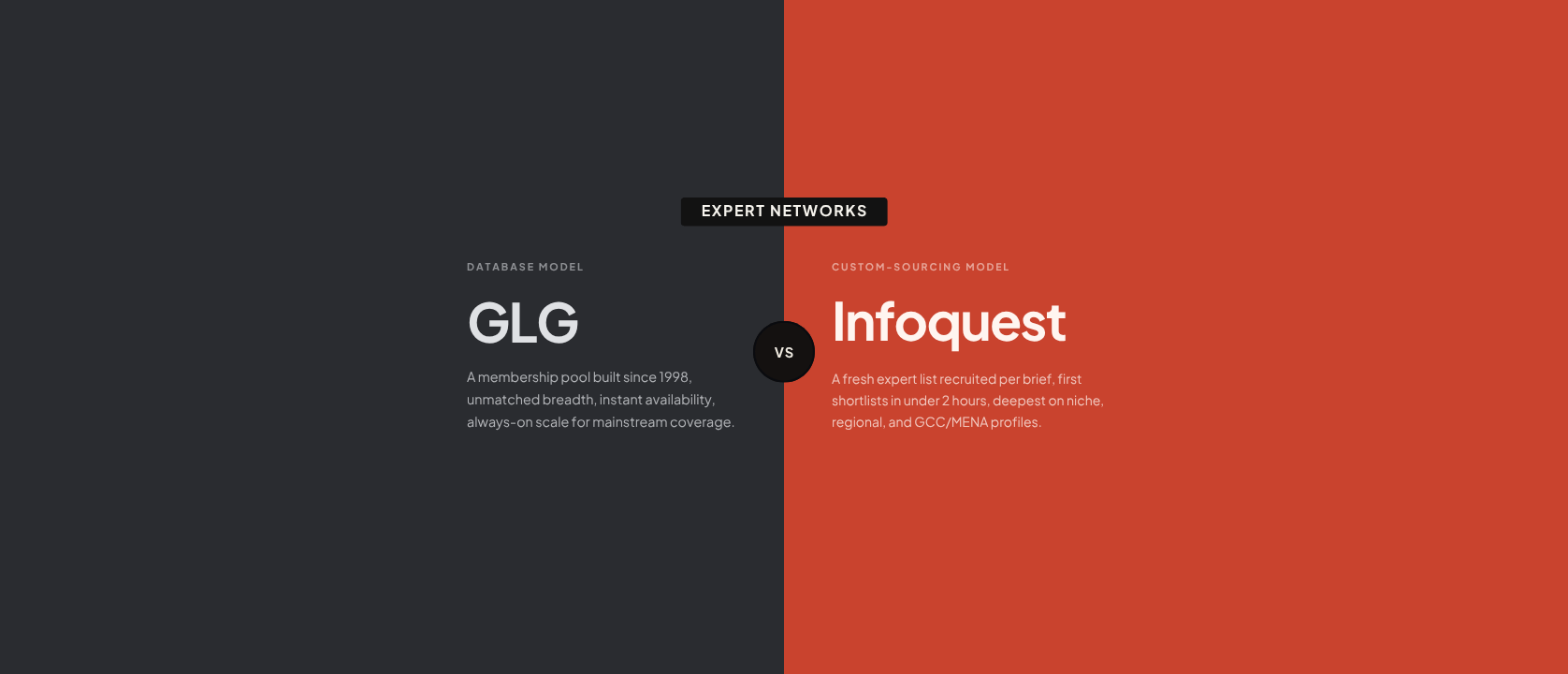
Infoquest and GLG solve expert access with opposite models: GLG matches your brief against the industry’s largest standing database, unmatched breadth, always-on scale, and two decades of institutional infrastructure, while Infoquest recruits a fresh expert list for every brief, delivering custom-sourced shortlists in under 2 hours on flexible, commitment-free packages at roughly 30% below legacy rates. GLG wins on breadth and enterprise volume; Infoquest wins on niche precision, regional depth, speed, and cost structure. Many buyers ultimately use both, in different roles.
The Real Difference: Sourcing Model
Everything else on this page follows from one architectural choice. GLG’s model: a membership database built since 1998, the category’s largest, searched and matched against your request. Its strengths are structural: coverage across virtually every industry and geography, instant availability of previously vetted profiles, and the accumulated infrastructure of the category’s pioneer. Its trade-offs are equally structural: matching surfaces who’s in the pool, the same well-known profiles recur across clients (“professional experts” accumulate call mileage), and depth thins where database membership does, narrow niches, private-company ecosystems, frontier markets, non-English operating layers.
Infoquest’s model: no standing pool to search, each brief triggers a recruitment sprint against your exact question, producing named profiles who often have never taken a paid call. Its strengths mirror the database’s gaps: precision on rare profiles, freshness, and reach into GCC/MENA and emerging-market operating layers. Its structural trade-off is honest too: recruitment can’t match a database’s instant breadth across dozens of simultaneous mainstream workstreams, which is why the models complement more than they compete.
Speed: Two Different Clocks
GLG is fast where the database is deep: covered, mainstream topics can produce matches quickly from existing profiles. Infoquest’s speed claim is different in kind: a first custom-recruited shortlist in under 2 hours regardless of whether anyone relevant sat in a pool beforehand, because recruitment runs in parallel, with vetting alongside. The skeptic’s question, “really, or marketing?”, deserves the honest answer: test it. Send both providers the same hard brief (niche, regional, or urgent, not a Fortune-500 commodity topic) and time the first relevant shortlist. Speed claims in this category are cheap; a two-hour pilot is not.
Match Quality: Flood vs Shortlist
The complaint buyers voice most about large-database matching is profile volume: twenty keyword-matched CVs where three screened experts were wanted, each irrelevant profile costing review time. This is a model property, not a GLG failure, pools reward and recall. Custom sourcing inverts the economics: because every profile is recruited against the brief, the deliverable is a short list with screening rationale per name, and quality shows up as low rejection and cancellation rates rather than volume. Buyers who want the database’s breadth and tight screening should say so explicitly in the brief, and judge any provider, us included, on profiles-per-brief and rejection rate over a pilot, per the method in our guide to choosing an expert network.
Compliance: Same Standard, Different Vintage
GLG’s compliance framework is the category’s institutional benchmark: two decades of MNPI controls, vetting, and audit infrastructure shaped by the most demanding regulated clients, and for some enterprise compliance teams that vintage is itself the deciding factor. Infoquest applies the same category standard: identity and employment verification, conflict and sanctions screening, topic pre-clearance, signed attestations, audit trails, run in parallel with recruitment so rigor doesn’t cost the speed advantage. Both should be verified the same way: in writing, against the checklist in our expert network compliance guide.
Commercial Model: Commitments vs Flexibility
GLG’s structures, subscriptions and credit blocks, price well for enterprises with steady, high, predictable volume, and poorly for anyone else: unused commitments are the category’s highest hidden cost. Infoquest’s structure is the inverse: flexible packages with no commitments, priced per brief at roughly 30% less than the legacy rate, spend maps to usage, which is why the model fits boutiques, mid-size firms, episodic deal flow, and precision-layer roles. The decisive question isn’t whose rate card is lower (neither is published, and structure dominates rates anyway, see our pricing models guide): it’s whether your demand pattern matches a commitment or punishes it.
Verdict: Which to Use, by Situation
Choose GLG when: you run high, steady call volume across many mainstream sectors and geographies; you want one enterprise relationship with maximum breadth; your compliance team weighs two decades of institutional vintage; or always-on access matters more than per-brief precision.
Choose Infoquest when: the brief is niche, regional, urgent, or private-company-shaped; you need GCC/MENA or emerging-market operating layers, including Arabic-speaking profiles; your demand is lumpy, and commitments would waste; or you want fresh experts without call mileage on conviction-critical questions.
Use both when: you’re a large buyer with genuinely mixed demand, GLG as the breadth layer, Infoquest as the precision layer. That stack, not vendor loyalty, is how sophisticated buyers increasingly structure the category; the full landscape sits in our comparison of the best expert networks and the switching view in our GLG alternatives guide.
FAQ
Infoquest replaces database matching with per-brief recruitment: instead of searching a standing pool, it sources a fresh expert list against your exact question, custom-sourced expert lists, first shortlists in under 2 hours, with vetting run in parallel, on flexible packages with no commitments at roughly 30% below legacy rates. Traditional networks like GLG excel at breadth, and always-on volume from their pools; Infoquest is built for the briefs pools handle worst: niche, regional, urgent, and hard-to-source.
On covered mainstream topics, a deep database can be very fast; that’s its structural advantage. Infoquest’s under-2-hour first shortlist applies regardless of prior coverage, which matters precisely on the briefs where databases start from zero. The claim is designed to be tested: run one hard brief through both and time the first relevant shortlist.
For enterprise breadth, steady high volume, and institutional vintage, yes, and this page says so plainly. For niche precision, regional depth, speed on hard briefs, and commitment-free economics, no. “Better” is a property of the brief, not the brand; the verdict section above maps which situations favor which.
Yes, it’s an increasingly standard configuration: GLG (or a peer database) as the volume layer for mainstream coverage, Infoquest as the precision layer for niche, regional, and urgent work. The stack logic is covered in our guide on when to use an expert network.
Neither publishes rate cards, and structure matters more than rates: GLG’s subscriptions and credits reward predictable enterprise volume; Infoquest’s commitment-free packages at roughly 30% below legacy rates reward variable and episodic demand, where the biggest savings come from eliminating unused commitments, not headline-rate differences.