
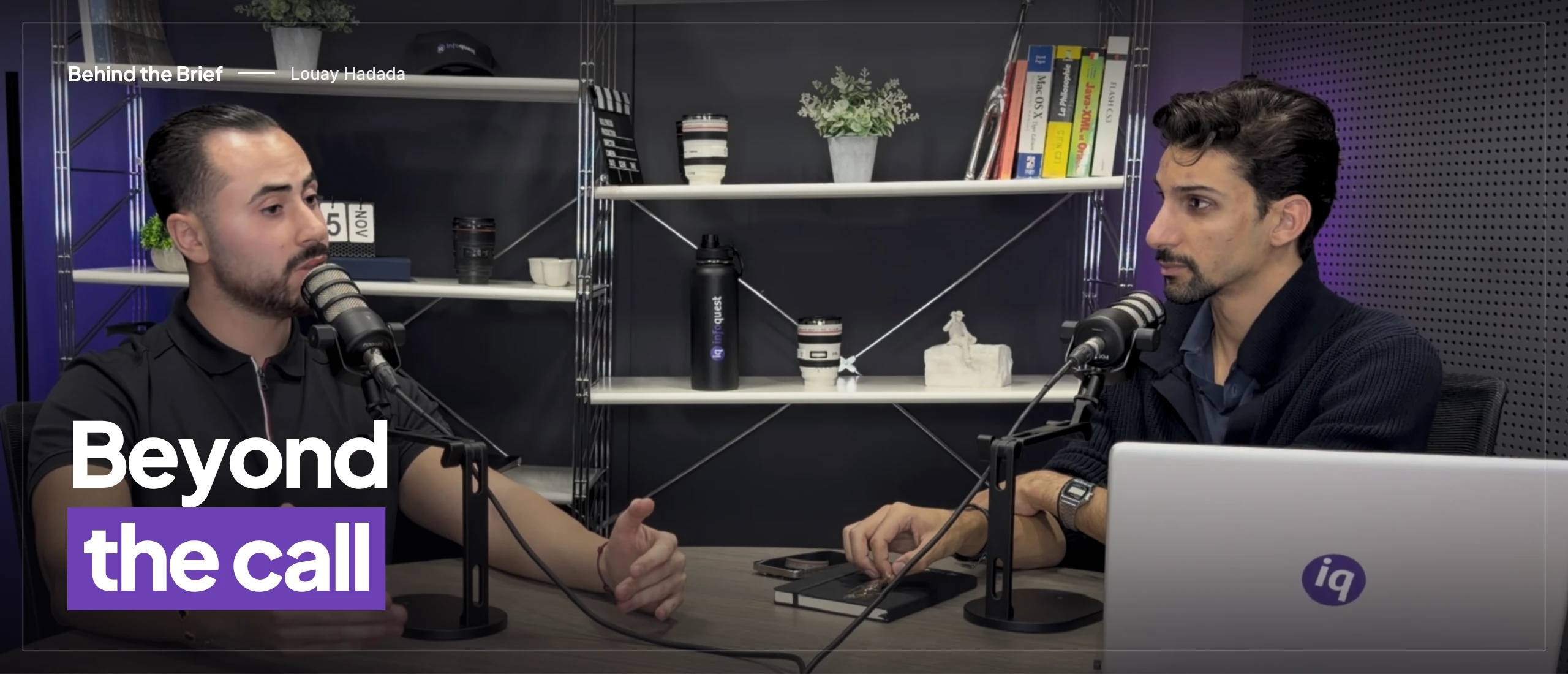
An interview with Louay Hadada, Associate Manager at Infoquest. Behind the Brief, episode 1. Hosted by Nabil Kanaan.
Most of what makes an expert network call useful happens before anyone dials in. It starts with a short conversation about the brief, continues through dozens of calls to experts who could say no, and ends with a client deciding whether the shortlist was worth their time. Louay Hadada runs that process every week as an Associate Manager at Infoquest, leading project delivery, operations and client communication. In the first episode of Behind the Brief, he walks through it from the first outreach to the client’s feedback.
Key takeaways
- Every project starts with a 5-minute call with the client team about the context, the geographies that matter and the companies to target.
- Senior experts say yes for more than the fee: access to top-tier consulting teams, a read on their own industry and a conversation worth having.
- When a first list misses, the project manager calls the client, goes through the profiles together and realigns the search.
- Consultants want a short, custom-sourced list of 5 to 10 experts, not 50 profiles to filter.
- The three complaints Louay hears most about expert networks are flexibility, speed and profile fit.
- After a good call, more clients now ask for written follow-ups from the expert, and surveys when they need many voices.
What happens between a brief and an expert saying yes?
Watch this part of the episode (1:06)
It starts with a phone call rather than a database search. “The moment we receive a brief, the project manager, myself, we hop on a call with the client team,” Louay says. “We have a quick 5-minute chat, understanding what they’re looking for, understanding the context behind the project.” The call is short, but it does two jobs: it shows the client that the team cares about the work, and it surfaces what the written brief leaves out.
On that call, Louay goes through the limits of the brief, the geographies of main interest and the companies the team should look at. He takes it back to the associates on the project, sets the project up on Infoquest’s platform and divides the target companies between them. From there the custom sourcing begins, which in practice means “lots of cold calling, lots of expert outreaching, onboarding experts on the project.” Each associate goes into those calls knowing the context of the client’s work, which is what lets them explain to a senior expert why this particular conversation matters.
Why do experts say yes to an expert network call?
Watch this part of the episode (2:26)
Hard-to-reach experts say yes when the call is worth more to them than the fee. Louay doesn’t pretend money is irrelevant. “If you want to incentivize an expert to hop on a call, then definitely money is something you’re looking at,” he says, especially when the expert is a former CEO. What Infoquest does differently is build a relationship with experts so that the fee is not the only reason they say yes.
Instead of leading with money, associates show experts what else the call offers. “They’ll be connecting with top-tier consulting firms,” Louay says, which for a senior operator means a conversation with the teams advising their competitors, customers and investors. Experts also learn what the client is working on and how the market sees their own industry. And the call itself should be one they enjoy. “It’s not just money,” he says. “It’s more than money. It’s having that relationship with the expert, them actually enjoying and hopping on that call.” An expert who enjoyed the last call takes the next one. For how experts are checked before they ever reach a client, see how expert networks vet experts.
How has the expert side changed in the last two years?
Watch this part of the episode (3:40)
Experts now know what expert networks are, and that has changed the first conversation. “Two years ago, I used to call an expert and give them a full 2-minute brief on what the industry is,” Louay says. “Now I just ask them, ‘Have you done these calls?’ And they’re like, ‘Yeah, we definitely know the industry.’”
That familiarity cuts both ways. It has made experts easier to reach, because fewer of them need convincing that the call is legitimate. It has also made them more aware of the rates on offer. The relationship, and a clear reason why this call is worth their time, is what keeps the right expert on the project.
What should happen when the first list misses?
Watch this part of the episode (5:24)
When a first list misses, the right move is a phone call, not a second list. It does not happen often, “to be completely honest, not too often,” Louay says, but when it does, the project manager acts first. “The first thing you do is pick up the phone and call the client. You’re trying to have that 5-minute chat to go through these profiles together.” The call asks why the profiles don’t fit, what the client is actually looking for and which details the team should take back to the search.
The cause is rarely one-sided. Louay describes it as “a mix of both: a brief and a misalignment on the sourcing efforts,” and sometimes the first list does useful work anyway. On one project, the client told him: “After you shared with us these profiles is where we got insights actually into what we need.” Reading the first profiles helped the client see their own brief more clearly, and the team realigned the search from there. For what goes into a strong brief from the start, see how to write a good expert network brief.
Why is a short list better than a long one?
Watch this part of the episode (7:14)
A consultant has to read every profile they are sent, and their time is the scarcest thing on the project. “You’re a consultant, you already have a million things that you’re doing,” Louay says. A list of 50 profiles turns the network’s job into the consultant’s job: filtering. So Infoquest custom-sources each project and shares “those 5 to 10 top experts,” which lets the client “look at only 10 instead of 50, evaluate them, give feedback, and proceed from there.” When ten profiles miss, the reason is visible in minutes rather than hours.
In Louay’s experience, the long list is something clients almost never ask for. “I think it’s a misconception that consultants are looking for a big list of experts,” he says. “They’d rather have a small list, targeted list, that they could work with.”
What do consultants complain about most?
Watch this part of the episode (8:44)
Louay hears the answer on the engagement call he runs after every project, a conversation meant to put a face to the name and find out what went well and what didn’t. He always asks for both: “Please tell me what were the positive things you’ve seen working with us, and please let me know what the negatives are.” Across those calls, the same three complaints about expert networks come up again and again.
- Flexibility. Consultants remember who was there when the work got hard. “We really appreciate you guys when you respond late at night, when you pick up the phone when it’s tough,” is the kind of thing Louay hears.
- Speed. One consultant told him about a network that “haven’t responded for over a day.” For a team in a sprint, a day of silence can cost the call that mattered. Infoquest works to Under 2-hour delivery on first profiles; see how urgent expert calls work.
- Profile fit. Experts who match the brief, rather than a long list the consultant has to filter.
All three come back to the same thing: a network that treats the project as its own.
What do consultants want beyond the call?
Watch this part of the episode (12:23)
Expert calls are still the main service, but what surrounds them is growing. “The expert calls would remain the most requested service,” Louay says. “But what we’ve seen is lots of surveys, lots of written deliverables, especially after calls.” The typical case is a client who has a good one-hour call and still has questions. Rather than book a second call, they write a follow-up questionnaire, Infoquest shares it with the expert, and the answers come back in writing.
Surveys answer a different need. “Sometimes you don’t need one or 2 very targeted calls, but rather you need 50 participants to fill out a customer review,” Louay says. His rule of thumb is simple: if you need mass data, run a survey; if you need targeted insight from one or two experts, book the hourly call.
What would Louay change about expert networks?
Watch this part of the episode (14:06)
Less than you might expect. Asked what he would change about how expert networks work, Louay’s answer is to go further in the same direction: more focus on the client and on the relationship. “Showing them that we actually care, telling them that, you know, we’re partners,” he says. “If you reach out late at night, I’ll be there for that client.”
Being a partner also means helping shape the project, not only supplying names. The client knows its market better than any network does, but the network can judge whether a given expert actually fits the brief, and should say so. That is how the first list becomes the right one. To plan the call itself, see our guide to expert network calls, and for how consulting teams compare providers, see the best expert networks for consulting firms.
FAQ
The fee matters, but senior experts also value access to top-tier consulting teams, insight into their own industry and a conversation they enjoy.
Ask for a short call with the project manager to go through the profiles together. Explaining why they don’t fit usually shows what the brief left out.
Infoquest shares a custom-sourced shortlist of about 5 to 10 experts, so the client can evaluate them quickly instead of filtering a long list.
Flexibility, speed and profile fit: being reachable when the work is hard, answering within hours, and sending experts who match the brief.
When you need input from many participants, such as 50 people completing a customer review. For targeted insight from one or two experts, an hourly call fits better.
Full transcript
Read the full conversation (lightly edited for readability)
Nabil Kanaan [0:00]: This isn’t really a podcast. It’s insights into how Infoquest operates, from a person who is Infoquest, really. How about a quick intro about yourself: when you joined and what you do now at Infoquest?
Louay Hadada [0:23]: Thanks, Nabil. My name is Louay Hadada. I joined Infoquest one and a half years ago, in February. I’m an Associate Manager and I manage a team. My main roles are project delivery, everything related to operations, client comms and, lastly, people management.
Nabil Kanaan [0:51]: The topic for today is how Infoquest operates from the minute a client sends us a brief to the minute an associate closes an expert and confirms with them. Walk us through that story. What happens when you first get a brief, and what happens from there until your associate closes an expert?
Louay Hadada [1:18]: The moment we receive a brief, the project manager, myself, hops on a call with the client team. We have a quick 5-minute chat, understanding what they’re looking for and the context behind the project. That’s important because it shows them we care about the project and about understanding what they’re working on. We go over the brief, understand any limitations, the geographies of main interest and any companies we need to be looking at, and I take that back to the team working on the project. We set up the project on our platform, divide the companies between the team and begin our custom sourcing.
Nabil Kanaan [2:08]: And then the associate starts looking.
Louay Hadada [2:13]: Exactly. The associate will be doing lots of cold calling, lots of expert outreach and onboarding experts on the project.
Nabil Kanaan [2:25]: I previously worked as an associate before moving into marketing, and we get a lot of questions from clients about why an expert doesn’t want to participate. Is it about the money? What are the reasons we usually get?
Louay Hadada [2:51]: Generally speaking, if you want to incentivize an expert to hop on a call, money is definitely something you’re looking at, especially when we’re talking with a former CEO. But what we’ve done differently at Infoquest is build a relationship with our experts. Instead of putting money up front as the main reason for the call, we show them the benefits. They’ll be connecting with top-tier consulting firms. They’ll learn more about what the client is working on and about the industry they’re in. It’s not just money. It’s more than money. It’s having that relationship with the expert, and them actually enjoying the call.
Nabil Kanaan [3:40]: Has the response from experts changed over the past couple of years?
Louay Hadada [3:45]: That’s a very interesting question. Something we’ve noticed lately is that many more experts know about expert networks: they know these types of calls and that the industry exists. That has created two things. Generally, it has become easier for us to reach experts. But experts also understand the market now, including the different rates on offer, and some ask for more. Our associates handle that through negotiation. That’s the main trend we’ve noticed.
Nabil Kanaan [4:43]: When expert networks first started out, experts often didn’t know what they were. “What is this? Is it a scam?” Nowadays it’s “Oh, okay, I know this.”
Louay Hadada [5:04]: Exactly. Two years ago, I used to call an expert and give them a full 2-minute brief on the industry. Now I just ask, “Have you done these calls?” and they say, “Yes, we know the industry.” I don’t even need to explain it.
Nabil Kanaan [5:20]: That makes things easier.
Louay Hadada [5:22]: It does.
Nabil Kanaan [5:24]: Say you’ve closed a list of experts and sent the first list, and it happens sometimes in the industry that it isn’t exactly what the client is looking for. What do you do when the client says, “Interesting profiles, but not exactly the ones we want”? And how often does that happen?
Louay Hadada [5:47]: To be completely honest, not too often. But when it does, the first thing a project manager does is pick up the phone and call the client, to understand what went wrong. You have a 5-minute chat to go through the profiles together: why don’t they make sense, and what exactly are they looking for? You take those details back to the team working with you on the project, show them what the client is actually looking for, and take it on from there.
Nabil Kanaan [6:25]: Is it usually a problem with the brief or with the network?
Louay Hadada [6:31]: It can be a mix of both: the brief and a misalignment in the sourcing. I’ll give you an example. Once, I called the client and they told me, “After you shared these profiles with us, we actually got insight into what we need.” We launched our efforts and sent the list, they went through it and realized they needed something different. That helped the client understand better what they wanted, and it allowed us to realign our efforts and get them better profiles.
Nabil Kanaan [7:13]: Is that what separates an average network from a good one? You send the list and then you collaborate on it?
Louay Hadada [7:25]: One thing we’ve done differently at Infoquest is position ourselves as partners on the project. We’re trying to help the client get the details right. And some networks send a first list of 50 to 80 expert profiles. That really doesn’t save time. As a consultant, you already have a million things to do. Receiving a list of 50 experts and having to go through and filter them is really difficult. What we do is custom-source and select the 5 to 10 top experts the client is looking for, and share those. That lets them look at 10 instead of 50, evaluate them, give feedback and proceed from there.
Nabil Kanaan [8:26]: That takes us to the consultant’s perspective. You do a lot of engagement calls. For everyone watching, what is an engagement call?
Louay Hadada [8:49]: An engagement call usually happens after the project. We hop on a call with the client to put a face to the name, get to know them and have a friendly discussion, but also to understand what went well and what went wrong. I always ask the client, “Please tell me the positives you’ve seen working with us, and please let me know what the negatives are,” because we focus on the negatives to fix them.
Nabil Kanaan [9:23]: Our business development team also hears a lot about the issues clients have with other networks and with the industry in general. So what are the most common complaints you hear, not about Infoquest, but in general?
Louay Hadada [9:48]: The top three are flexibility, speed and profile fit. On flexibility, I’ve heard lots of clients say, “We really appreciate you when you respond late at night, when you pick up the phone when it’s tough and when we’re working on something difficult.” The second is speed. One consultant told me they reached out to a network and didn’t get a response for over a day. That’s really a problem. The third is the one we’ve touched on: the list you send. Are you sending 50 experts from your network, or a targeted list the client will actually use?
Nabil Kanaan [10:44]: Interesting. What do networks get wrong about what consultants want? From a marketing perspective, I see a lot of networks promoting things like “We have a large database.” What do clients really care about?
Louay Hadada [11:04]: To be completely honest, Nabil, I’ve never heard a client tell me they want 50 experts on the first list. What clients tell us is, “We really appreciate that you send a small list. You save us time, we know we’re selecting the best profiles, and you share the profiles that meet our requirements exactly.” There’s rarely a profile that doesn’t fit. I think it’s a misconception that consultants are looking for a big list of experts. They’d rather have a small, targeted list they can work with.
Nabil Kanaan [11:47]: That matches a complaint I’ve heard too: consultants getting 50 profiles in a first list, spending around an hour going through them, and finding one or two very good ones while the rest are irrelevant. A smaller, focused list where most profiles fit is what clients want. To close on what clients are looking for: everyone knows expert networks offer expert calls. Have you seen a trend toward other types of services?
Louay Hadada [12:35]: Expert calls will remain the most requested service. But we’ve seen lots of surveys and lots of written deliverables, especially after calls. For example, a client has a one-hour call with an expert and really likes them because they gave good insights. Instead of booking another call, they send a written questionnaire as a follow-up that can take the expert an hour or two. We share it with the expert, they fill it out and we share it back with the client.
Nabil Kanaan [13:19]: Was that never happening before, or has it increased?
Louay Hadada [13:23]: It happened before, but we’re seeing it more now. Surveys are the other one. Sometimes you don’t need one or two very targeted calls; you need 50 participants to fill out a customer review so you can get some insight. That’s where surveys come in. They’re quick, they’re easy and they cost less. If you’re looking for mass data, you’d go for a survey. If you’re looking for targeted insight from one or two experts, you’d go for the hourly call.
Nabil Kanaan [13:57]: Makes sense. To close: if you could change how expert networks work in general, how they serve clients or present themselves, what would you change?
Louay Hadada [14:16]: That’s a really interesting question. I thought about it in relation to Infoquest. It’s not something I would change about what we do, but rather focusing more on what we’re already doing: focusing more on the client and on the relationship, showing them we actually care and that we’re partners. If a client reaches out late at night, I’ll be there for them. I personally wouldn’t change anything about what we do at Infoquest.
Nabil Kanaan [14:50]: So it’s about improving on what you already have. I’d also add that being a partner isn’t only about flexibility. It’s about supporting the project itself: not just providing experts, but helping work out whether the experts the client wants are exactly what they need. The client knows the market better than we do, but we understand whether a given expert actually fits the brief. It’s about thinking and working together. Some networks send 40 profiles and that’s it, with no follow-up on the next list, or they keep sending the same profiles. That’s not how we do it. Louay, thank you again for this interview. Hopefully we’ll do another one on another interesting topic.
Louay Hadada [16:02]: Looking forward to it. Thanks, Nabil.