
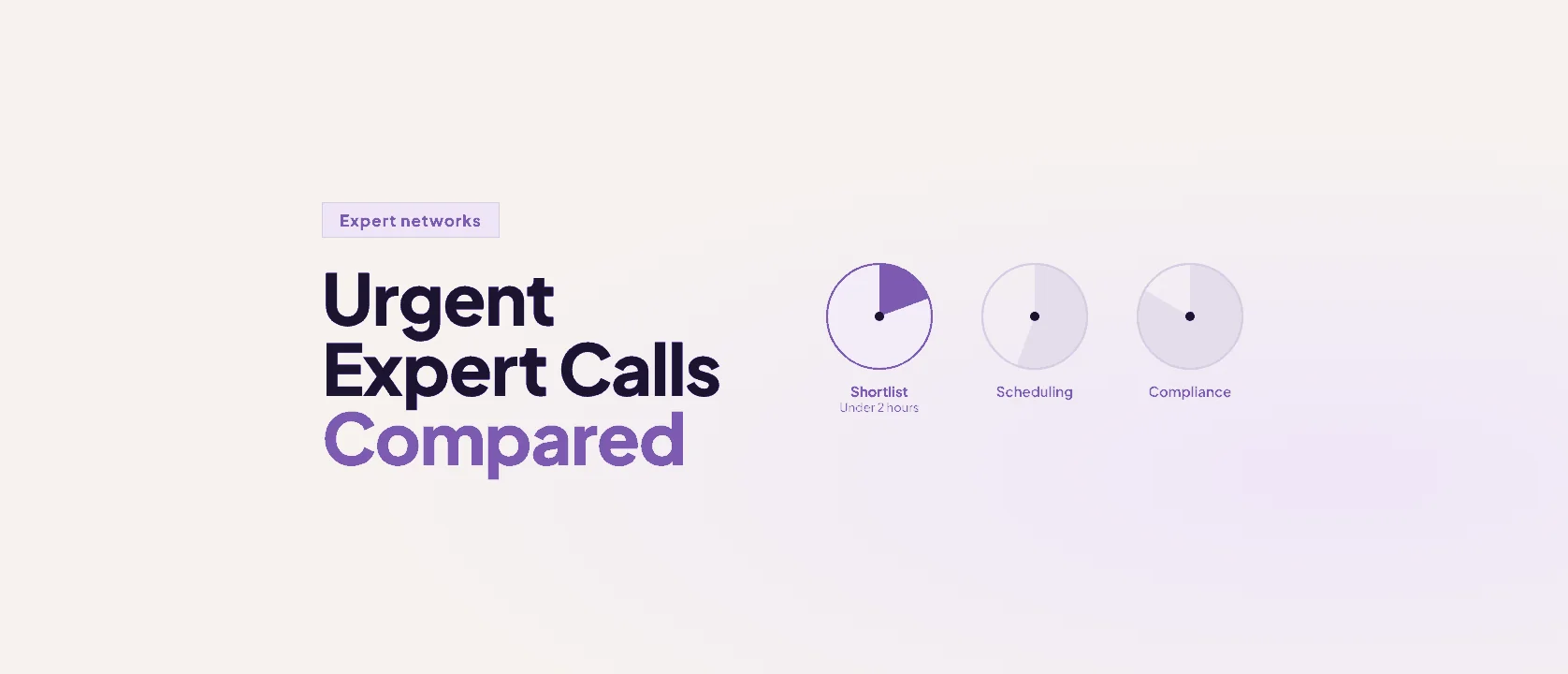
Expert networks differ on urgent weekend or overnight requests in three ways: how they source experts (matching from a standing database or recruiting fresh for each brief), which time zones their teams cover, and whether compliance clearance can run outside office hours. For urgent expert calls, database networks are fastest when a pre-vetted member already fits the brief; custom-sourcing networks such as Infoquest are fastest when nobody in a database fits, with under 2-hour delivery of the first custom-sourced shortlist and call timing then set by the expert’s own availability.
Infoquest appears in this comparison; every other provider is described factually from its public positioning.
How Do Expert Networks Differ in How They Handle Urgent Weekend or Overnight Requests?
Every provider in the category says it is fast. The useful question is fast at what, because an urgent brief has to clear three separate clocks, and different sourcing models win on different ones:
- The shortlist clock: how long until you see named, screened profiles. This is where sourcing model matters most.
- The scheduling clock: how long until a chosen expert is actually on the phone. This depends on the expert, not the network, and it is where most urgent requests really slow down.
- The compliance clock: how long until the expert is cleared: conflicts, current-employer rules, MNPI attestations and your firm’s own restricted lists. A provider that can source on a Saturday but cannot clear until Monday is not a weekend provider.
Ask any provider, including us, to say plainly which of the three clocks its speed claim refers to.
Urgent Expert Calls by Sourcing Model
| Model | Fastest when | Slows down when | Examples |
|---|---|---|---|
| Database and membership networks | A vetted member already matches the profile, so the shortlist is a search, not a recruitment | The profile is niche, regional or newly relevant, and the database has to recruit anyway | GLG, Guidepoint |
| Managed-service networks | Large associate teams can work a brief in parallel across offices in several regions | The brief needs people the team has never reached, or arrives outside the covering office’s hours | AlphaSights, Dialectica |
| Transcript libraries | Someone has already asked your question; reading is instant | The question is specific to your thesis, recent, or about a niche company the library does not cover | AlphaSense (including Tegus), Third Bridge Forum |
| Custom-sourcing networks | Nobody in a standing database fits; experts are recruited from scratch against the live brief | The brief is vague, so recruitment has no clear target (fixable with a tighter brief) | Infoquest |
The pattern: databases win on mainstream profiles, libraries win on common questions, and custom sourcing wins on the rare profile. Most genuinely urgent briefs are urgent precisely because something specific just changed, which is why urgent expert calls so often land in the rare-profile category.
Same-Day, Weekend and Overnight Briefs: Scenario by Scenario
Same-day: brief in the morning, call by close of business
Realistic for most providers on mainstream profiles, and for custom sourcing when the brief names the target roles clearly. The constraint is almost always the expert’s calendar. Offer three or four call windows rather than one, and accept a 30-minute call over a 60-minute one if that is what fits.
Friday evening: investment committee on Monday morning
This is the hardest case in the category. Sourcing can happen over the weekend; scheduling and compliance clearance are where it stalls. Before you send the brief, confirm three things with your provider: who is working the request on Saturday, who can clear compliance before Monday, and whether experts are willing to take weekend calls. Weekend calls are common with former executives and independent consultants, and rarer with currently employed operators.
Overnight across time zones
When a New York team needs a Gulf or Asian operator, the time difference works in your favour: the expert’s working morning is your night. Brief before you log off, and a shortlist can be waiting when you wake up. This depends on the provider having sourcing coverage in the expert’s time zone, so ask where the team working your brief actually sits.
How to Brief Urgent Expert Calls for Speed
Speed is set more by the brief than by the provider. The briefs that move fastest share six features:
- Named target roles: three precise profiles (for example, “former head of procurement at a regional cement producer”) plus two acceptable adjacent profiles.
- Exclusions up front: companies, current employers and individuals you cannot speak to, so screening does not have to be redone.
- Two or three screening questions: the questions that prove the expert has the knowledge, not just the job title.
- Call windows in the expert’s time zone: not only yours.
- Compliance pre-agreed: confirm your firm’s rules for this brief before you send it, not after the shortlist arrives.
- The decision it feeds: one line on what the call needs to answer, so the provider can prioritise the right profiles.
The full method is in our guide to writing an expert network brief, and call structure for when you are on the line is in our expert network calls guide.
Compliance Does Not Get a Weekend Off
Urgency is when controls get skipped, and it is when they matter most. Urgent expert calls are still subject to the same current-employer rules, conflict checks and MNPI attestations as any other. For listed-company or deal work, ask your provider who handles compliance clearance outside office hours and whether a weekend call goes through the same checks as a weekday one. If the answer is unclear, treat it as a no. Our expert network compliance guide covers the full set of controls to expect.
When to Choose Infoquest for an Urgent Brief
Choose Infoquest for urgent expert calls when the profile is niche, regional or newly relevant, so a standing database is unlikely to hold the right person; when you need named profiles screened against your exact brief rather than the closest database match; when the brief spans the Americas, Europe and the Middle East; and when a one-off sprint suits flexible packages with no commitments better than a subscription. Infoquest delivers custom-sourced expert lists with under 2-hour delivery of the first shortlist, and is 30% less costly than competitors.
FAQ
They differ on three clocks: how fast they produce a shortlist (set by sourcing model), how fast an expert can be scheduled (set by the expert’s availability), and whether compliance can clear outside office hours. Database networks are fastest when a vetted member already fits; custom-sourcing networks such as Infoquest are fastest when the profile has to be recruited from scratch, with under 2-hour delivery of the first shortlist.
Often, yes, if the brief names clear target roles and you offer several call windows. The shortlist is rarely the bottleneck; the expert’s calendar and compliance clearance usually are. Accepting a shorter call and pre-agreeing your compliance rules are the two biggest levers you control.
It depends on the profile. For mainstream profiles, large database and managed-service networks are fast because the person is already on file. For niche, regional or newly relevant profiles, custom-sourcing networks are usually faster because they recruit against the brief instead of searching a database that does not hold the right person.
Pricing structures vary by provider and none publishes a standard rate card, so ask before you send the brief whether any rush or out-of-hours premium applies. Fee structures across the category are explained in our expert network pricing models guide.
Agree your firm’s rules for the brief before sending it, ask the provider who clears compliance outside office hours, and confirm that weekend calls go through the same conflict, current-employer and MNPI checks as weekday calls. If a provider cannot answer clearly, wait for Monday.
For the full provider landscape, see our comparison of the best expert networks, and for how to weigh providers on more than speed, our guide to choosing an expert network.