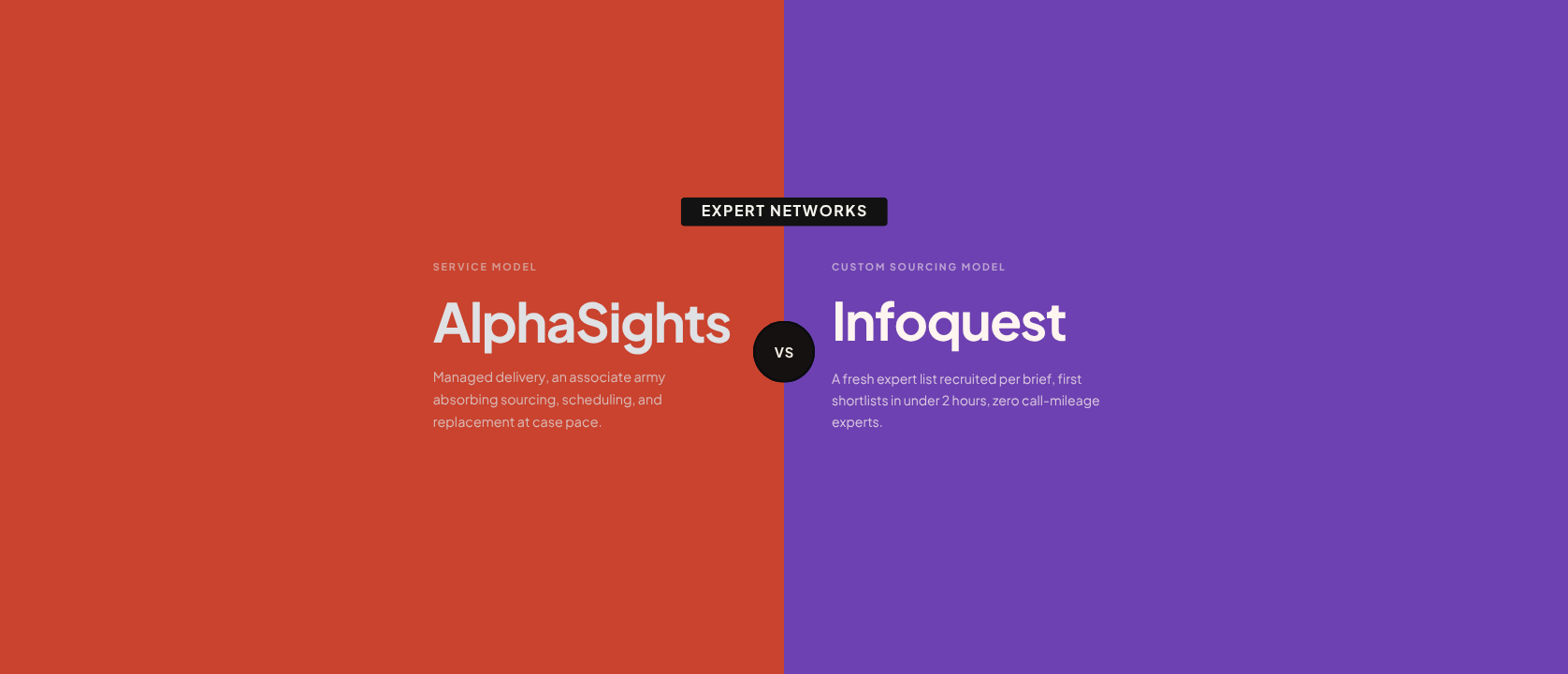
Infoquest and AlphaSights represent the two strongest post-database answers to expert access, solving different halves of the problem. AlphaSights industrialized delivery: dedicated associate teams executing sourcing, scheduling, and replacement end-to-end at premium, commitment-based scale. Infoquest rebuilt sourcing: a fresh expert list recruited per brief, first shortlists in under 2 hours, on flexible, commitment-free packages at roughly 30% below legacy rates. Choose AlphaSights for managed volume at case pace; choose Infoquest for niche, regional, and urgent precision without commitments. Teams with both needs increasingly run both.
The Real Difference: What Each Firm Industrialized
AlphaSights’ machine is service: a large associate workforce that absorbs the entire logistics burden, brief intake, candidate outreach across its network and beyond, screening, scheduling, replacement, delivered with an intensity consulting case teams rate as the category benchmark. The model’s structural costs follow from its structure: premium pricing that funds the associate layer, commitment-based terms that suit steady volume, and an engagement tempo not every buyer wants.
Infoquest’s machine is recruitment: no standing pool as the primary asset, but a sourcing engine that builds a named, screened shortlist against each brief, including profiles who’ve never taken a paid call, with vetting run in parallel and delivery in under 2 hours. The structural costs are equally honest: no associate army wrapped around every engagement, a leaner service texture, and a brand that enterprise procurement teams know less well than a decade-old premium incumbent.
Both firms out-recruit a static database; the difference is what surrounds the recruiting, managed scale versus per-brief precision economics.
Speed: Managed Fast vs Sourced Fast
AlphaSights is genuinely fast, managed-fast: associates compress every step and case teams feel it as responsiveness across a whole program. Infoquest is sourced-fast: the under-2-hour first shortlist applies per brief, including briefs where no network has prior coverage, niche, regional, private-company terrain where managed outreach also has to start from scratch. On mainstream briefs the experienced speed difference narrows; on hard briefs the sourcing model decides it. Same standing offer as our GLG comparison: send both firms one hard brief and time the first relevant shortlist; the test costs an afternoon and settles the marketing question.
Match Quality and Service Texture
The models produce different deliverables. AlphaSights’ associate layer generates candidate flow with speed and volume, managed until the calendar is full, excellent when throughput is the goal, with the familiar large-network caveat that flow can outrun curation. Infoquest’s deliverable is the inverse: a short list with a screening rationale per name, quality measured in rejection and cancellation rates rather than options presented. On service: buyers who want a team living inside their engagement will prefer AlphaSights’ texture; buyers who want precision inputs without the tempo will prefer ours. Neither preference is wrong; write it into the RFP explicitly, per our guide to choosing an expert network.
Compliance
Both firms run the category-standard framework: identity and employment verification, conflict and sanctions screening, topic pre-clearance where sensitive, attestations, audit trails. AlphaSights brings the institutional depth of a premium incumbent serving regulated enterprises at scale; Infoquest runs the same controls in parallel with recruitment so rigor doesn’t tax the speed. Verify either in writing against the checklist in our expert network compliance guide.
Commercial Model: The Sharpest Contrast
This is where the two diverge most. AlphaSights’ commitment-based premium structure is rational for its model; the associate layer is a fixed cost, and prices well for firms with steady, high call volume. Infoquest’s flexible packages with no commitments price the opposite demand shape: lumpy, episodic, precision-weighted usage, at roughly 30% below legacy rates. The utilization audit decides it: if last year’s committed capacity went unused, the structure, not the rate card,was the cost. Method in our pricing models guide.
Verdict: Which to Use, by Situation
Choose AlphaSights when: you run sustained, high-volume call programs at case pace; you want the logistics burden fully absorbed by a dedicated team; enterprise familiarity and premium-incumbent assurance matter to procurement; steady volume makes commitments price well.
Choose Infoquest when: briefs are niche, regional, urgent, or private-company-shaped; you need GCC/MENA and emerging-market operating layers, including Arabic-speaking profiles; demand is lumpy, and commitments would waste; you want fresh, zero-mileage experts on conviction-critical questions, at challenger economics that stay challenger.
Use both when: a volume layer and a precision layer both earn their place, the stack configuration covered in our guide on when to use an expert network, with the full landscape in our comparison of the best expert networks.
FAQ
What they tell us they like: shortlist precision (a few screened names, not a flood), speed on hard briefs, spend that tracks sold casework instead of a subscription, and reach into regional and private-company profiles the big pools miss. What they dislike, honestly: we’re not built for massive always-on volume the way an associate-army model is; the service texture is leaner than a dedicated AlphaSights team; and our brand carries less procurement familiarity than a premium incumbent, which is why we’d rather win the comparison on a pilot brief than on this page.
Structurally, yes: flexible packages with no commitments at roughly 30% below legacy rates, with the larger savings usually coming from eliminating unused commitments rather than rate differences. For firms whose steady volume genuinely consumes an AlphaSights commitment, the gap narrows; utilization decides it.
For managed, high-volume delivery with a dedicated service layer, yes, plainly; that’s the model’s purpose, and it executes it at benchmark level. For niche, regional, urgent, and commitment-free work, no. As with every pairing in this category, “better” is a property of the brief.
Yes, and mid-size firms increasingly do: AlphaSights (or a database network) where volume is steady and mainstream, Infoquest for the niche, regional, and urgent layer, with the boutique economics covered on our consulting firms page. The switching landscape sits in our AlphaSights alternatives guide.
One hard brief (niche, regional, or urgent), identical to both firms, scored on four numbers: time to first relevant shortlist, profiles sent per brief, rejection rate, and replacement speed. An afternoon of process converts every claim on this page, ours included, into data.