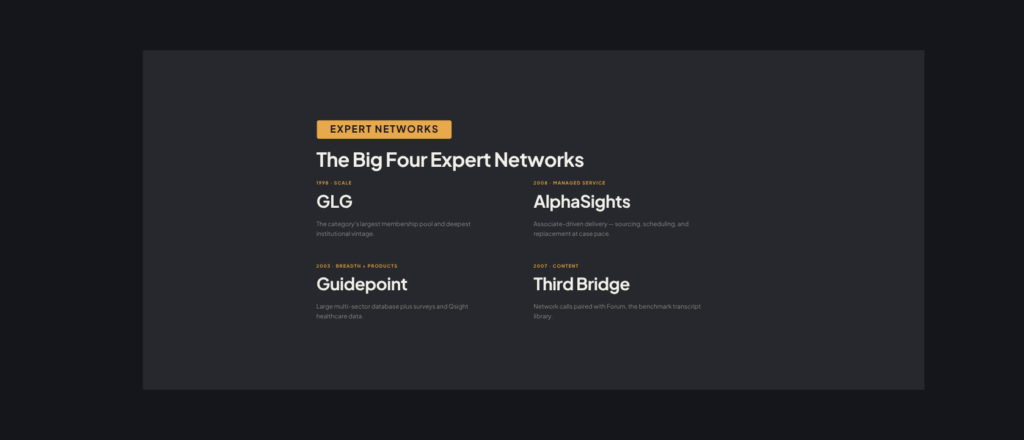
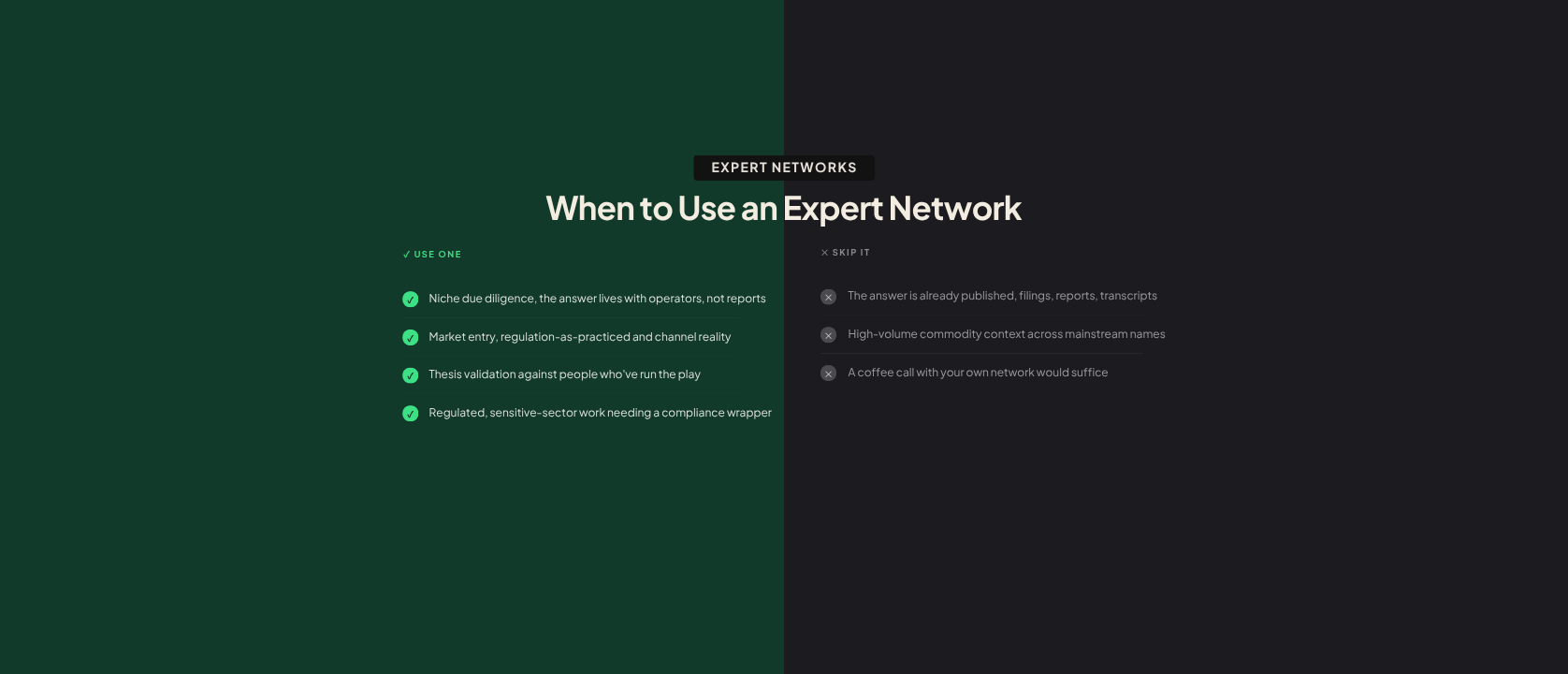
Use an expert network when a decision depends on knowledge that isn’t written down anywhere, niche diligence, market entry, thesis validation, regulated-sector questions, and the cost of being wrong exceeds the cost of the calls many times over. Skip it when the answer is publicly available, when you need deliverables rather than conversations, or when the work is high-volume commodity context that cheaper layers cover. And when a network is the right tool, the remaining question is sourcing model: database breadth or custom recruitment.
This guide includes the projects we’d tell you not to bring to us; an honest fit guide generates better clients than a persuasive one.
Projects That Genuinely Need an Expert Network
Niche due diligence
When the target’s value hinges on a specific supply chain, customer concentration, or competitive dynamic, the people who know are operators, and the cost asymmetry is total: a few calls against a nine-figure decision. Deal-specific guidance is on our private equity and hedge funds pages.
Market entry
Regulation-as-practiced, channel reality, and incumbent behavior live in people, not reports. The four-profile entry mix- regulatory veterans, incumbents, channel operators, comparable-entry executives- is the canonical network use case, mapped in our regional guides for MENA and Asia.
Thesis and strategy validation
Before capital or a client recommendation commits, pressure-testing against people who’ve run the play is the cheapest available insurance, especially where the thesis contradicts consensus, since consensus is exactly what published sources contain.
Regulated and sensitive sectors
Healthcare, financial services, public-sector-adjacent work: here the network isn’t just sourcing; it’s the compliance wrapper, vetting, conflict screening, confidentiality, audit trails that make expert input usable at all. The standard is in our expert network compliance guide.
Projects That Don’t Need One (Honest Guardrails)
Answers that are published. If a capable analyst can find it in filings, industry reports, or a transcript library in an afternoon, paying expert-call rates for it is a waste. Do the reading first; spend calls on what reading can’t answer.
Deliverables. Networks sell conversations. If you need a model built, a survey scripted end-to-end by someone else, or interim capacity, a freelance marketplace or consultancy is the right tool; the full comparison is in our expert networks vs Q&A platforms guide.
High-volume commodity context. Continuous background coverage across many mainstream names is transcript-library and database terrain; the economics of custom work don’t fit it, and forcing them to is the most common way buyers overspend on the category.
Questions where five minutes with your own network suffices. Genuinely, if a former colleague can answer it on a coffee call, make the coffee call.
Custom Sourcing vs Database: The Decision Rule
Once a project clears the fit bar, one rule routes most briefs correctly: how many people in the world can answer your actual question? If the answer is “hundreds”, mainstream sector context, common operator perspectives, a database network’s breadth wins on convenience and cost. If the answer is “a handful”, a specific niche, a private company’s ecosystem, a frontier market, an Arabic-speaking operating layer, custom sourcing is the only model that reliably finds them, because it recruits against the brief instead of searching a pool. Infoquest’s version of the model: custom-sourced expert lists, first shortlists in under 2 hours, on flexible packages with no commitments at roughly 30% less cost than legacy competitors. The full six-criteria evaluation sits in our guide to choosing an expert network.
Stacking: The Configuration Most Teams End Up With
The fit and routing logic above resolves, for most research-heavy teams, into a stack rather than a winner: published sources and transcripts for the known, a database or managed network where call volume is genuinely high and mainstream, and a custom-sourcing specialist for the precision briefs. Small teams often run just the first and last layers. The point of this page is that each layer has a failure mode when asked to do another’s job, and the spend problems buyers attribute to “expert networks” are usually routing problems.
FAQ
High-volume commodity coverage: continuous calls across dozens of mainstream, developed-market names, where a database’s standing pool and subscription economics genuinely win. Also anything a transcript library already answers. Infoquest’s model earns its keep on niche, regional, urgent, and hard-to-source briefs, and we’d rather route a mismatched project correctly than win it.
Each brief triggers a fresh recruitment sprint: named profiles identified against your exact question, screened, and delivered as a first shortlist in under 2 hours. The projects that benefit most are those where the right people aren’t on any panel, private-company ecosystems, emerging markets, narrow technical niches, and where recycled “professional experts” would contaminate the findings.
Several providers offer managed research beyond calls, survey programs, synthesized findings, and longer-term advisory. But if the need is a fully-owned deliverable with recommendations, that’s consulting, not expert access; networks work best feeding your team’s judgment rather than replacing it. Match the vehicle to who owns the thinking.
Providers combining documented engagement controls, conflict screening against live tenders, client anonymity, vetting records, with genuine access to the relevant operators. In regions where public-sector work concentrates, regional sourcing depth matters as much as the controls; both dimensions are covered in our compliance guide and MENA & GCC guide.
Weigh the decision’s downside against the engagement’s cost; the ratio is usually decisive in one direction or the other. Then check the routing: if reading answers it, read; if a conversation is needed, ask the how-many-people question above and pick the sourcing model accordingly. The provider landscape is in our comparison of the best expert networks.