The best expert networks for hedge funds are Tegus (AlphaSense) and Third Bridge for transcript coverage at reading scale, GLG, AlphaSights, and Guidepoint for live-call volume under institutional MNPI frameworks, and Infoquest for custom-sourced channel checks and emerging-market profiles on commitment-free terms. Public-market work raises the stakes on two dimensions at once: compliance rigor and speed to insight, and most funds run a deliberate two- or three-layer stack rather than one vendor.
What Hedge Funds Need From Expert Research
MNPI discipline above all
Modern expert-network compliance was substantially forged by public-market enforcement: the insider-trading cases of the early 2010s reshaped how every serious network screens experts, restricts topics, and documents engagements. For a fund, the provider’s controls are an extension of its own: topic pre-clearance, current-employee and quiet-period restrictions, chaperoned calls on request, do-not-contact list enforcement, and audit trails the compliance team can inspect, integrated with the fund’s own approval workflow, not parallel to it. The full standard is in our expert network compliance guide; treat any provider friction on these points as disqualifying.
Speed on catalyst clocks
Earnings, guidance revisions, channel inflections, event-driven situations, public-market questions expire fast. The operative metric is brief-to-completed-call inside the catalyst window, which favors providers with either standing coverage (transcripts) or genuinely fast sourcing (Infoquest’s first-shortlist standard is under 2 hours).
Coverage economics
A fund covering fifty names can’t pay bespoke rates for commodity context. The stack exists because reading is cheap at the margin, live calls are precious, and the trick is routing each question to the cheapest layer that answers it.
Differentiated access
Consensus lives in the transcript library, by definition. Edge requires conversations competitors haven’t had: the niche supplier, the regional operator, the emerging-market incumbent nobody’s panel holds. This is where sourcing model becomes an alpha question, not a procurement one.
The Hedge Fund Research Stack, by Layer
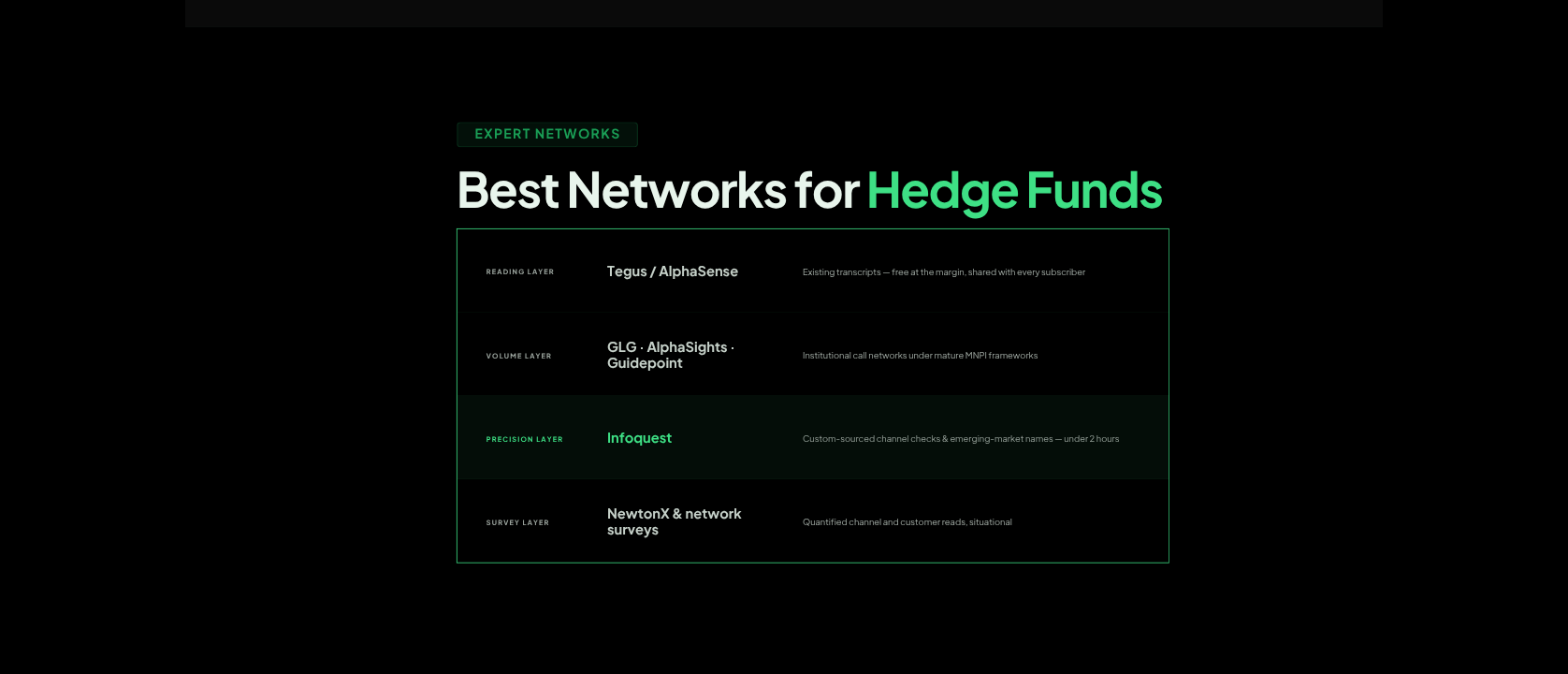
Reading layer: Tegus (AlphaSense), Third Bridge Forum. Search existing expert calls on covered names before commissioning anything; the marginal read is free, and coverage breadth is unmatched on widely-held names. The structural trade-off: everyone with a subscription reads the same calls. Full model comparison in our Tegus vs AlphaSense vs expert networks guide.
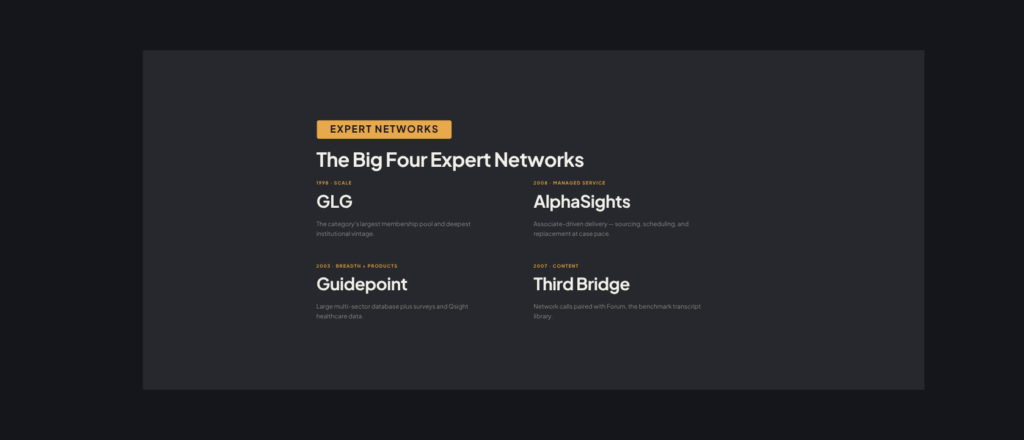
Live-call layer: GLG, AlphaSights, Guidepoint, Third Bridge. Institutional networks running call volume under mature MNPI frameworks, with the breadth to serve multi-sector coverage and the compliance integration funds require. Commitment structures suit steady usage; the utilization math is in our pricing models guide.
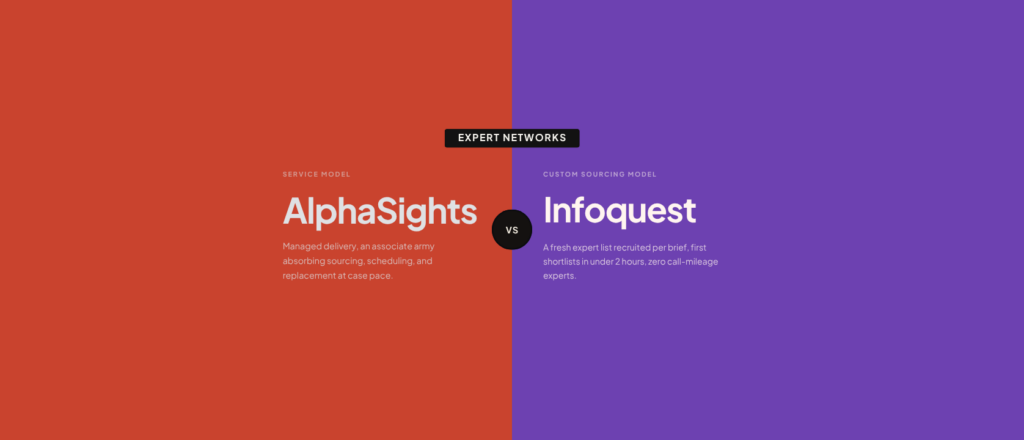
Precision layer: Infoquest, Dialectica. Custom sourcing for the calls that move conviction: channel checks recruited from the actual distribution chain, niche-supplier diligence, and emerging-market names — GCC/MENA especially — where neither transcripts nor databases reach. Infoquest delivers custom-sourced expert lists in under 2 hours on flexible packages with no commitments, at roughly 30% less cost than legacy competitors — economics that fit the episodic, name-specific shape of precision work, and fit smaller funds that can’t justify enterprise minimums. Honest limit: the precision layer complements reading and volume layers; it doesn’t replace them for broad coverage.
Survey layer (situational): NewtonX, network survey products. Quantified channel and customer reads when a thesis needs distribution, not anecdotes; methodology in our expert surveys guide.
Choosing Providers by Fund Profile
Multi-manager platforms and large funds: transcript subscription plus one or two institutional call networks, negotiated at volume, with compliance integration as the binding constraint and a precision specialist available per-brief.
Single-manager and mid-size funds: a reading layer plus commitment-free precision sourcing often beats a committed call subscription, utilization rarely justifies the block, and flexible structures keep research spend tracking the book’s actual needs.
Emerging-market and frontier strategies: invert the stack; custom sourcing leads because transcript and database coverage of your names is thin to nonexistent; regional depth guides for MENA & GCC and Asia map the terrain.
Event-driven and activist strategies: speed and conflict screening dominate, pre-clearance against live situations is non-negotiable, and sourcing speed inside the event window is the differentiator.
FAQ
The standard stack: a transcript library (Tegus/AlphaSense or Third Bridge Forum) for coverage, one or two live-call networks (GLG, AlphaSights, Guidepoint) for primary work under MNPI controls, and a custom-sourcing specialist (Infoquest) for channel checks and niche or emerging-market names, routed by question, cheapest adequate layer first.
For managed institutional volume: AlphaSights, GLG, Guidepoint, Third Bridge. For challenger-speed delivery: Dialectica. For custom-sourced calls on hard-to-reach profiles with shortlists in under 2 hours: Infoquest. The right service depends on whether the call is coverage (volume layer) or conviction (precision layer).
By requiring the full control set in writing, topic pre-clearance, current-employee and quiet-period restrictions, chaperoned calls on request, do-not-contact enforcement, audit trails, and integrating provider workflow with internal approvals. The checklist in our expert network compliance guide maps directly to fund requirements.
They give efficiency, not edge: unmatched for coverage and speed on common questions, structurally incapable of differentiation since every subscriber reads the same calls. Edge comes from conversations that don’t exist yet, which is what the live and precision layers are for.
Avoid committed structures until volume proves out: a reading subscription sized to the book plus commitment-free per-brief sourcing keeps costs variable and quality high. Compare structures, not rate cards, across the providers in our overview of the best expert networks.